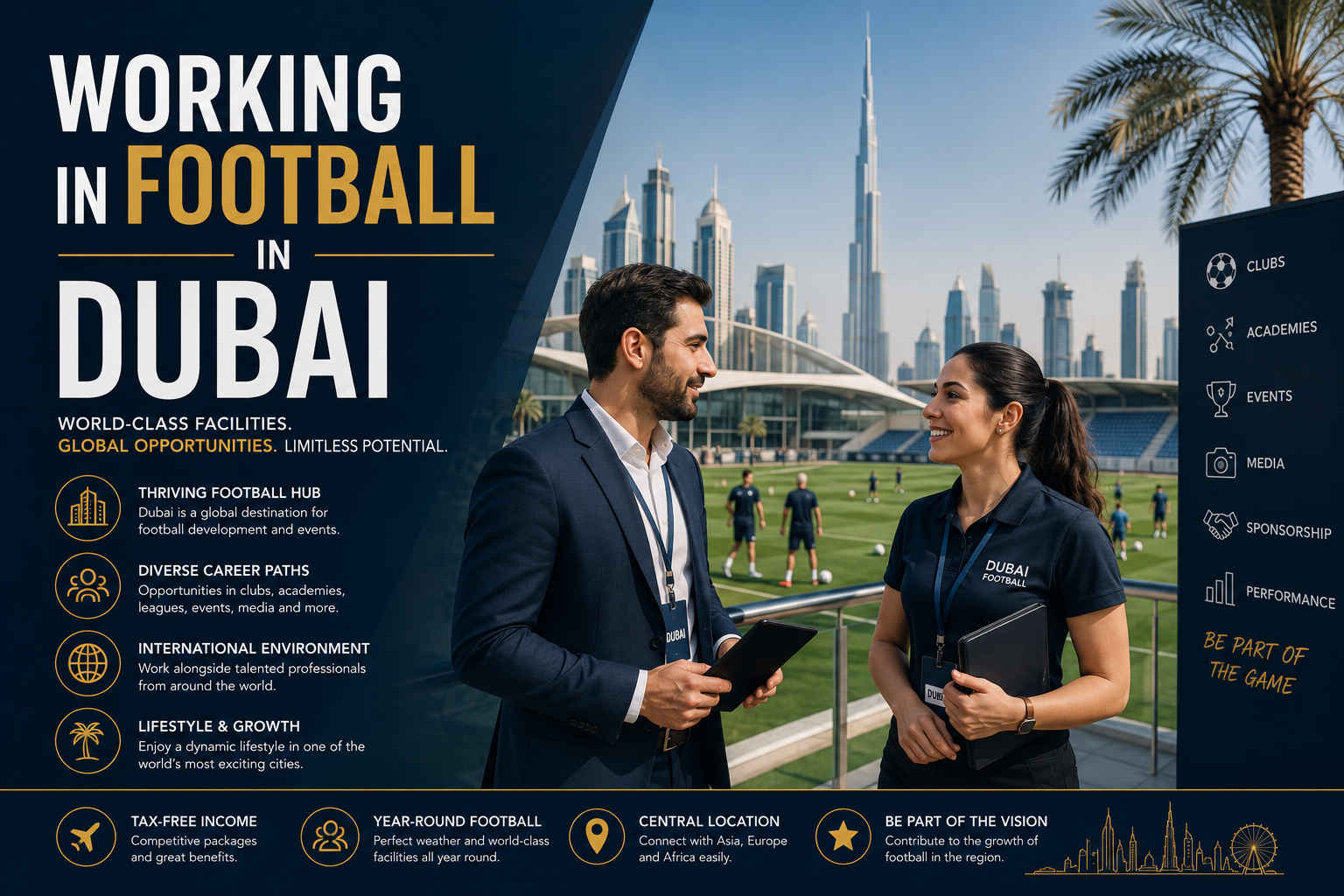

For football professionals thinking about working abroad, Dubai has become one of the most talked-about destinations on the planet. Tax-free salaries. World-class facilities. Year-round sunshine. A rapidly growing football landscape. And a city that is genuinely investing in sport at every level.
But beyond the lifestyle headlines, what does working in football in Dubai actually look like? What types of roles are available? How much can you earn? What qualifications do you need? And what do the people already out there think?
This guide, written for the Jobs4Football community, is designed to answer all of those questions, whether you're a coach, scout, analyst, sports scientist, technical director, or any other football professional considering a move to the UAE.
Dubai is one of the seven emirates that make up the United Arab Emirates (UAE). Situated on the northwest coast of the Arabian Peninsula, it borders Saudi Arabia and Oman, sits just down the Gulf coast from Qatar and Bahrain, and is a short flight from Kuwait and Iran.
In footballing terms, it places you at the heart of one of the most rapidly developing regions for the sport. The Middle East is investing heavily in football — and Dubai is right in the middle of that story.
Key facts:
The UAE Pro League is growing steadily in stature. Foreign ownership is now permitted in the top two divisions for the first time, bringing fresh investment, more international players, and increasing demand for experienced foreign coaching and support staff.
Dubai's three professional clubs are Al Nasr, Al Wasl, and Shabab Al Ahli. Dubai City FC has also attracted attention, particularly from the British football community, as a club with strong links to UK football professionals working their way up through the UAE football pyramid.
Elsewhere in the UAE, Al Ain gained international recognition when they defeated River Plate in the 2018 FIFA Club World Cup — a result that showed the growing quality in the region.
The private academy sector is where the vast majority of football jobs in Dubai sit. There are dozens of academies operating across the city, ranging from grassroots participation programmes to high-performance environments for talented young players.
Many major European clubs have franchised operations in Dubai, Juventus, for example, runs an academy programme there. Alongside these are independent academies and sports education companies catering to an international, affluent community.
The coaching work in this environment is varied. You will likely work with everything from three-year-olds in foundation programmes through to teenage players in competitive squads. Being comfortable with the full spectrum of coaching, from participation to performance, is important.
Women's football in the UAE is growing, albeit at a slower pace than the men's game. Opportunities do exist, and the region is increasingly aware of the need to develop the women's game, particularly as global attention on it intensifies.
Football professionals should understand that Dubai sits within a broader Middle East football ecosystem. Saudi Arabia, Qatar, and Bahrain are all within easy reach, and a network built in Dubai can open doors across the entire Gulf region.
The range of roles available to non-playing football professionals in Dubai is broader than many people realise.
Coaching roles are the most common entry point, particularly at academy and grassroots level. However, there is also demand for:
The honest truth, as football professionals who have worked there will tell you, is that a significant proportion of Dubai football employment is at academy and school level. But for those who arrive with the right attitude, the right credentials, and the willingness to build a network on the ground, progression into more senior roles is very achievable.
One of the most compelling reasons to consider Dubai is the financial package. There is no income tax in the UAE, which immediately makes even a modest salary significantly more valuable than its equivalent in the UK.
Typical packages for football professionals vary depending on the role and the employer:
Many full-time roles in the academy sector include visa sponsorship, health insurance, and sometimes accommodation. The more senior the role, the more likely a comprehensive package is.
Important caveat: Setting up in Dubai does involve upfront costs. Deposits are required for accommodation, and the cost of living (particularly food and going out) is higher than many people expect. Budgeting carefully for the first three to six months is essential.
Beyond qualifications, employers in Dubai value people who are adaptable, culturally aware, and capable of working with diverse nationalities and abilities. You will coach players from across the world, South Asia, East Africa, the Arab world, and Europe, often in the same session.
Working legally in Dubai requires a sponsored work visa. The process is straightforward but involves several steps, and your employer typically manages much of it on your behalf.
1. Entry Visa (Pink Visa) Your employer applies for quota approval through the UAE Ministry of Labour, submits an employment contract, and secures an employment entry visa on your behalf. Once issued, you have 60 days to enter the UAE.
2. Emirates ID Upon arrival, you must apply in person at an Emirates Identity Authority (EIDA) centre, providing biometrics (fingerprints and photograph) and documentation including your passport and entry visa.
3. Residence Visa and Work Permit After obtaining your Emirates ID, you apply for a residence visa. A UAE residence visa is typically valid for one to three years and is renewable. Your work permit is incorporated within this.
Family sponsorship: Once you hold your own residence visa, you can sponsor residency for family members.
The Jobs4Football team has gathered first-hand insights from coaches and football professionals who have lived and worked in Dubai. Here is what they want you to know.
This is one of the most common questions. The honest answer is: it varies considerably.
At professional club level, the standard is better than many people expect, and is improving year on year. In the academy sector, the top groups, referred to locally as "high performance", produce players of a similar standard to good youth players in the UK. But there is also a huge volume of recreational and participation coaching, and being adaptable across both is important.
As one experienced coach put it: "Within the pro league, better than people think. Under that it is very varied. Some top ex-pros playing in amateur leagues for fun. Private academies using it as a springboard for Europe, all in the same league as Sunday league players."
Every professional we've spoken to rates Dubai exceptionally highly for safety and quality of life. As one coach put it: "4th country I've coached and worked in, Dubai is by far the safest."
The social scene is vibrant, with a large and welcoming expat community. However, the professionals who thrive are typically those who invest time in understanding and engaging with the local culture, rather than living entirely within an expat bubble.
The summers are brutal. Temperatures regularly reach 45–48°C, and humidity is high. Outdoor football activity slows significantly between June and September. Factor this into your expectations.
The time difference works in your favour as a football fan. Champions League and European games often kick off in the early hours of the morning Dubai time — but if you work evenings, you'll be home in time for them.
The UAE football landscape is evolving quickly, and Dubai is at the centre of it. Key trends worth watching include:
Already in the UK or abroad? Apply directly for academy or school-based roles, many actively recruit internationally. A well-constructed football CV and a strong LinkedIn presence are essential. These are often the first things employers check.
➡️ Get your football CV right with our Jobs4Football CV resources
➡️ Improve your LinkedIn profile with Jobs4Football's career guides
Consider PE Teaching as an entry route Many football professionals enter the Dubai ecosystem through an international school PE position. This gives you legal residency, a solid income, and the time and local presence to pursue football opportunities alongside, often leading to a full transition into football.
Networking on the ground matters more than applications from afar Dubai, like most football markets, operates heavily on relationships. Being physically present, building connections, and demonstrating your work in person is significantly more effective than sending applications from thousands of miles away.
Build your digital footprint before you arrive Football clubs and academies in Dubai will Google you and check your LinkedIn. Make sure your online presence reflects your experience, philosophy, and professionalism.
If the answer to most of those is yes, Dubai could absolutely be the right next step.
If you're serious about building a football career overseas — whether in Dubai, Saudi Arabia, Qatar, or anywhere else in the world — Jobs4Football is the platform built for football professionals like you.
We connect coaches, scouts, analysts, sports scientists, technical directors, and other football professionals with opportunities across the global football industry. Our community is built around people who want to take their football career to the next level.
What Jobs4Football offers:
👉 Join Jobs4Football today and take your football career global
Whether you're actively job searching or just starting to explore your options, becoming part of the Jobs4Football community is one of the smartest career moves you can make.
If you found this guide useful, explore more of our career content for football professionals: