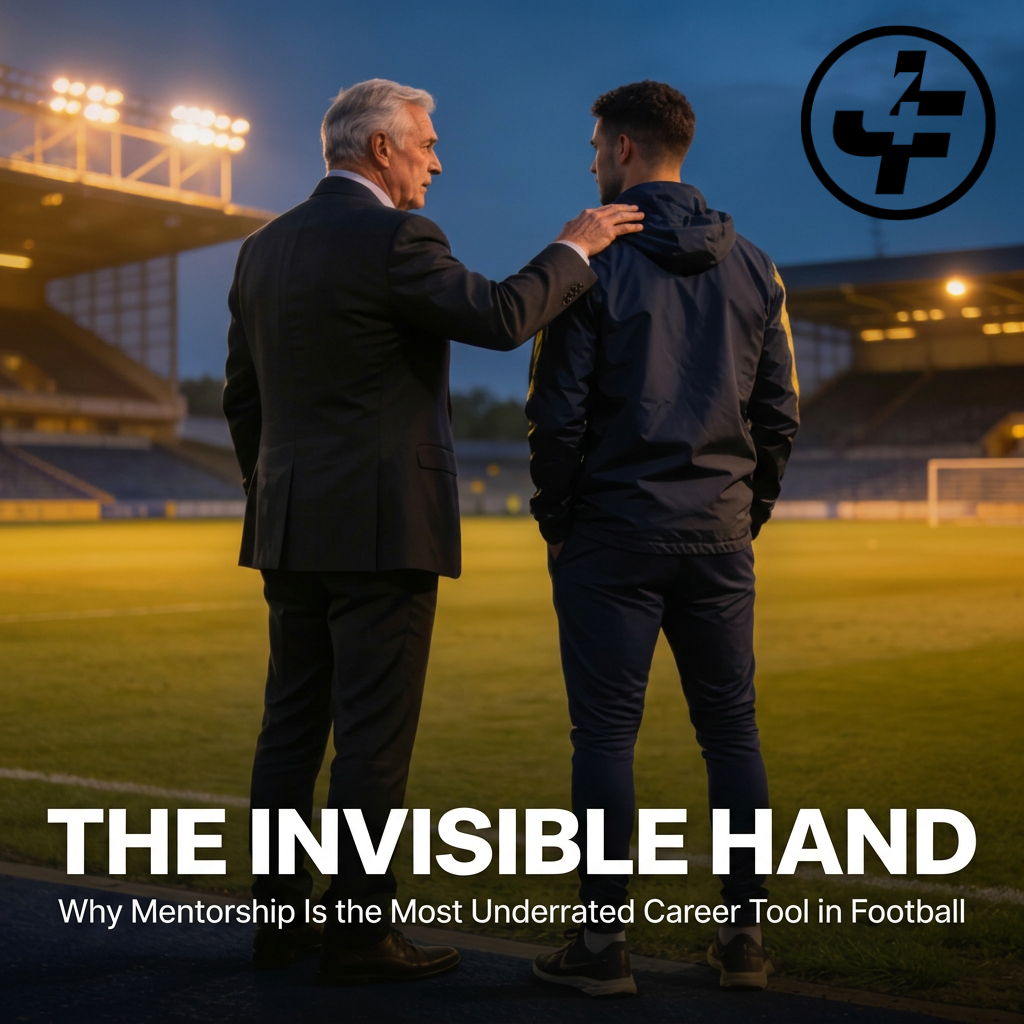
There is a moment in every football career, playing, coaching, or off-pitch, where raw talent stops being enough. Where the CV looks good on paper, the badges are in order, and the desire is unquestionable, yet the door still won't open. You can train or learn harder. You can apply again. Or you can find someone who has already walked that corridor and let them show you where the key is kept.
That is mentorship. And in professional football, it may well be the most powerful, most underused, and most underappreciated career tool available.
Football has always been, at its core, a relationship industry. The deals that get done, the roles that get filled, the careers that get made, they almost never happen in a vacuum. Research into recruitment in elite football consistently shows that trust and
"knowing the right people" are among the most critical factors in how non-playing roles are filled. Informal networks, peer recommendations, and personal credibility carry enormous weight in a world that talks about diversity and inclusion but still, quietly, hires based on who vouches for you.
Into this environment, mentorship offers something uniquely powerful: access. Not just access to information or industry knowledge, but access to the right people, at the right time, with the right word said on your behalf.
The Sports Industry Research Centre and others have confirmed that mentoring improves career outcomes in sport through enhanced skills, informational support, and social networking, all three of which are critical in football. But to understand just how transformative it can be, you only need to look at the people who run the game.
Ferguson, Guardiola, and the Mentorship Chain
To appreciate what mentorship does for a career in football, start at the very top.
Sir Alex Ferguson — 26 years, 13 Premier League titles, two Champions League trophies — is widely regarded as the greatest manager the game has produced. But Ferguson himself was shaped by those who came before him and understood, instinctively, that his most important job was passing that knowledge on.
Under his tenure at Old Trafford, Ferguson built a culture of mentorship that ran throughout the entire club. Young players like Ryan Giggs, Paul Scholes, and David Beckham were not simply trained — they were mentored, challenged, and given a roadmap within the club's values and identity. His belief was simple: if he could see potential in a player, it was his responsibility to develop the whole person, not just the footballer. The Netflix documentary on Beckham illuminated this perfectly, Ferguson acted not merely as a tactician but as a father figure, offering guidance that extended well beyond the training pitch.
And Ferguson did not reserve this generosity for his own squad. The Guardian reported that young managers around the game, Aidy Boothroyd, Tom Cleverley, and countless others received unsolicited phone calls, books, and tactical advice from Ferguson long after they had left his orbit. When Boothroyd was managing Watford in the Championship playoffs, Ferguson rang him. When Cleverley stepped into the Watford hot seat years later, Ferguson rang again. "He must have seen somewhere that I had accepted the position and we chatted for about 10 to 15 minutes," Cleverley recalled.
That is mentorship in its purest form. Not a structured programme, not a tickbox exercise, a phone call, freely given, from someone who understands that the game gets better when its people get better.
Guardiola's story tells the same tale from a different angle. Shaped profoundly by Johan Cruyff, who handed him his footballing philosophy at Barcelona, Guardiola became the apprentice who became the master. Under his tenure, Lionel Messi already exceptional became transcendent. Guardiola experimented with the "false nine" role and, through daily guidance, accelerated Messi's development into the goalscorer the world knows today. Two giants of the game, linked by a chain of mentorship that stretches back through decades.
This chain is not coincidence. It is culture.
The Hidden Workforce: Mentorship for Non-Playing Roles
Much of the conversation around mentorship in football focuses on players. But for the thousands of people who work in football off the pitch, analysts, recruiters, operations staff, welfare officers, commercial managers, scouts, the need for mentorship is arguably even greater, and the formal structures to support it even thinner.
University of Liverpool research led by Dr Dan Parnell on backroom staff recruitment in elite football found that networking, trust, and informal relationships dominate how clubs hire middle-management and support staff. There is rarely a structured pathway into these roles. More often, somebody knows somebody. A mentor opens a door.
There are six distinct non-playing career pathways in football: Business, Media and Technology, Governance, Education and Community, Coaching/Stadia/Operations, and Football Brands & Products. Each of these sectors is competitive, each is relationship-dependent, and — crucially — few of the people entering them have been formally introduced to what the path looks like from inside. A mentor who has navigated that terrain is worth more than any course or qualification.
The FA recognises this. Their Coach Mentor Programme, delivered through The Boot Room, offers bespoke one-to-one mentoring for coaches at various levels of the game — with a specific commitment to coaches from underrepresented backgrounds. England Football Learning's Mentee Development Programme goes further, offering a season-long placement for aspirational coaches specifically designed to accelerate their entry into the professional game. Research from The FA itself found that 40% of new grassroots coaches leave within their first two seasons — citing a lack of support and confidence as the primary reasons. Where structured mentorship exists, that figure drops significantly.
The Academy to First Team Gap
"One of the most acute mentorship challenges in professional football sits right at the point where the game should be most prepared: the academy to first-team transition."
Despite years of investment and the introduction of the Elite Player Performance Plan (EPPP) in 2012, the leap from academy to professional football remains, as a 2025 Staffordshire University study described it, "notoriously challenging". The study, which explored a programme called "Mentoring: Beyond Talent" at a Category One club, used recently retired professional players as mentors for academy scholars aged around 15-16. The results were significant: mentees reported stronger social support networks, improved ability to handle uncertainty, and greater clarity on their futures,both within and outside football.
What made the programme work was not just the knowledge transfer, but the relatability. A recently retired professional can speak to an academy player in a way no analyst or coach educator can. They know what it feels like to be told you're not good enough at 17. They know how quickly a career can turn on a single decision. That lived experience is the currency mentorship deals in — and it cannot be replicated in a classroom.
When the Playing Days End: Mentorship Through Transition
For those transitioning out of playing careers , whether at 19 after an academy release or at 35 after a full professional career, mentorship becomes the bridge between identities. Careersinfootball.com describes a pattern that will resonate with thousands: players who insist they don't want to go into coaching, only to find themselves six months later taking a training session because nothing else has materialised and someone asked them to help.
There is nothing wrong with coaching. But stepping into it because you drifted there, rather than because you chose it, is rarely the foundation for a fulfilling second career. The difference between drifting and deciding is, in most cases, someone who has been through it and helped you see the choice clearly.
This is precisely why the EFL and PFA's Off-Pitch Pathway Scheme (OPPS), launched in November 2025, is such a significant development. The scheme offers clubs a £25,000 funded role to give former players hands-on experience in non-coaching off-pitch positions — recruitment, operations, commercial, and more. It is a formal recognition that the game has been wasting enormous talent by failing to create structured bridges from playing career to professional football business career.
Mentorship does not always flow downward from experienced to inexperienced. Some of the most valuable mentoring in football happens between peers — two coaches at similar levels swapping sessions plans, two analysts challenging each other's models, two recruitment professionals talking through a candidate assessment.
Research from the Sports Industry Research Centre identifies peer mentoring as one of the most effective formats in sport, producing improvements in communication, collaborative problem-solving, and a deepening sense of professional identity. In grassroots football, senior coaches who mentor newer colleagues find that the act of mentoring sharpens their own thinking, improves their professional profile, and reduces the isolation that can come with leading sessions alone.
For
Jobs4Football, this is one of the most exciting opportunities the football jobs market currently offers. The professionals in your network, the people you trained alongside, worked with, or know through the game, are not just contacts. In the right dynamic, with the right intention, they are mentors in waiting.
What Good Mentorship Looks Like in Football
The best football mentorship relationships share certain qualities, regardless of whether they happen at the top of the game or the grassroots:
Trust before tactics. A mentor who cannot be trusted with uncertainty, failure, or doubt is only a training manual in human form. The relationships that move careers are built on psychological safety first.
Tailored, not generic. Ferguson never managed two players the same way. The best mentors assess what the individual needs, not what worked for someone else.
Reciprocal learning. Research consistently shows that mentors benefit as much as mentees, sharpened thinking, refreshed perspective, and stronger professional positioning.
Commitment over convenience. Mentorship is not a single conversation at a networking event. It is consistent, intentional engagement over time, the kind of relationship that means someone's career stays in your thoughts even when they are not in the room.
Whole-person development. The best football mentors understand that a player or professional who struggles off the pitch cannot fully flourish on it. Mental health, identity, life skills, and career planning are not separate from football development, they are central to it.
There is a cost to the absence of mentorship, and it is substantial. Forty percent of grassroots coaches walking away within two seasons. Academy players released at 16 with no clear guide for what comes next. Analysts and performance staff cycling through clubs on short-term contracts, never fully inducted into professional cultures, never given the guidance that would help them grow. Women and diverse coaches leaving the game because the pathways are opaque and no one has walked alongside them.
The game does not have a talent shortage. It has a mentorship shortage.
Where Jobs4Football Comes In
At Jobs4Football, we see this every day. The talent in this industry is extraordinary, people with qualifications, experience, drive, and passion who are one meaningful conversation away from the career they are working towards. Our Football Mentor Career Springboard programme exists precisely because we know that structured, personalised mentorship changes outcomes.
Whether you are a coach looking to break into professional football, an aspiring analyst building your data skills, a former player trying to find the right off-pitch role, or a sports business professional learning the specific dynamics of the football industry a mentor who has been there is not a luxury. It is a competitive advantage.
The game is full of people who made it because someone picked up the phone. Be the person who picks up the phone. Or better yet, find the right person and ask them to.
Join our Membership Support services today and have access to your mentor :
Signup | jobs4football