

There's a well-known truth in the football industry that most people only discover after they've already been job-hunting for a while: the majority of roles are never publicly advertised. They're filled through phone calls, recommendations, and trusted relationships, often before a vacancy even gets posted.
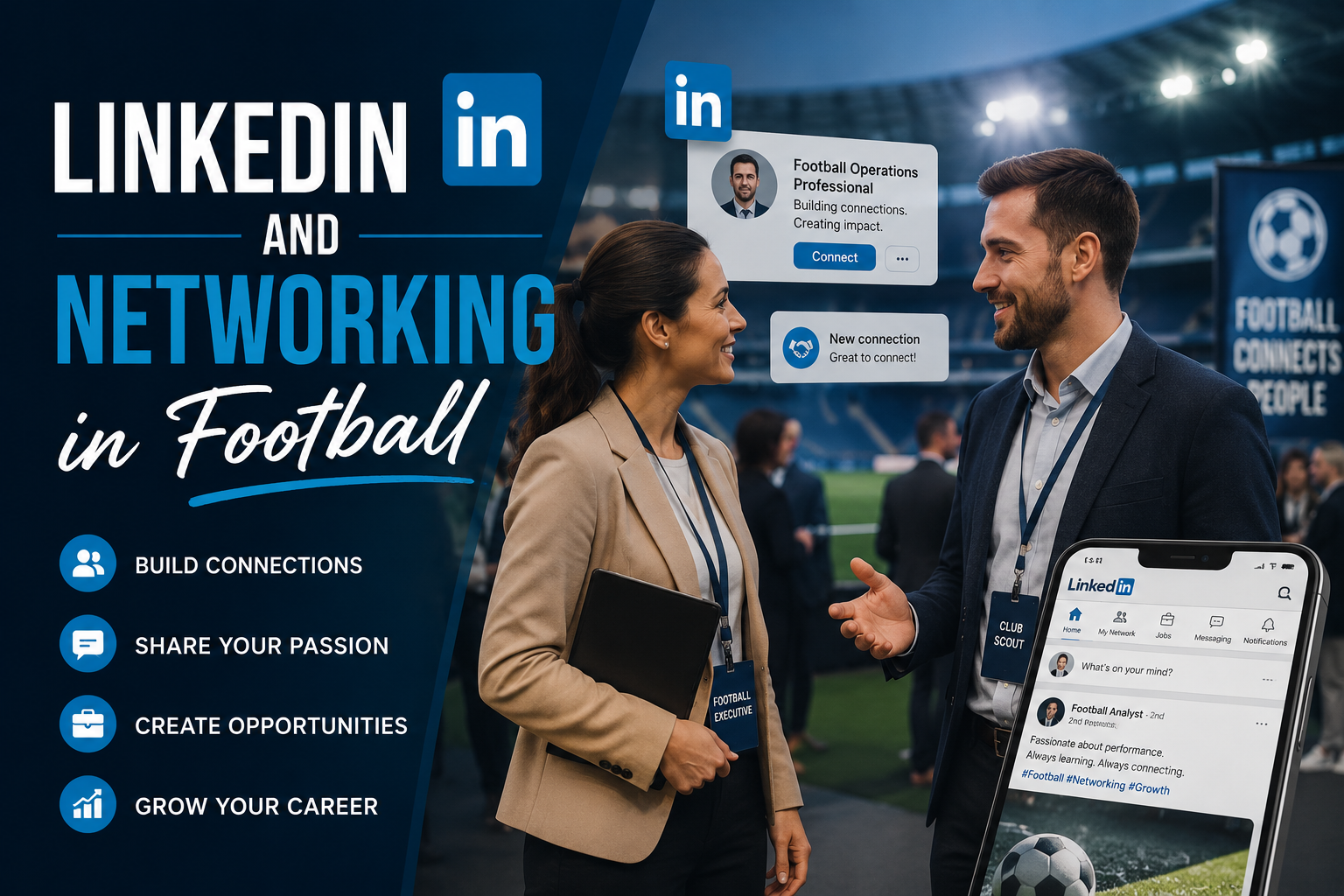
This is why networking in football isn't a nice-to-have. It's a core professional skill. And in the modern game, LinkedIn has become the single most important platform for building and leveraging that network, whether you're trying to break into football for the first time or you're an experienced professional looking for your next opportunity.
This guide covers exactly how to do it properly: how to build a LinkedIn profile that works for you, how to grow a network that opens real doors, how to create content that builds your professional reputation, and how to turn online connections into real-world opportunities.
Before getting into tactics, it's worth understanding why networking matters so much more in football than in most other industries.
Football is relationship-driven at every level. Clubs hire staff they know. Directors of Football promote coaches from within their networks. Scouts recommend analysts they've worked with before. Player care managers get approached for roles based on reputation, not job boards. The higher up the pyramid you go, the more true this becomes.
The implications for your career strategy are significant. You can have an excellent CV, a relevant qualification, and genuine ability and still struggle to get in front of decision-makers if nobody in the right circles knows you exist. Conversely, someone with a slightly thinner CV but a strong network, a visible presence, and good professional relationships will often move faster.
Networking isn't about being fake, schmoozing, or knowing the right people through luck. It's about making yourself known, being genuinely useful and engaged in your field, and building relationships over time, so that when opportunities do arise, your name comes up in the right conversations.
LinkedIn has become the professional backbone of the football industry. Coaches, scouts, technical directors, performance staff, and club executives all use it. Recruitment decisions are made or at least started, on the platform every single week.
Here's why it matters so much for networking in football specifically:
It gives you direct access to decision-makers. Unlike most platforms, LinkedIn allows you to connect with and message people at the highest levels of the game. A well-crafted connection request or thoughtful comment can put you on the radar of a Director of Football or Head of Academy who would otherwise be completely inaccessible.
It's searchable. Clubs and recruiters use LinkedIn to find candidates proactively. If your profile is well-optimised and clearly communicates what you do, people will find you — even when you're not actively applying for anything.
It builds credibility over time. Posting consistently about your work, your ideas, and your professional insights builds a public track record of your knowledge and expertise. Over months and years, that reputation becomes a genuine career asset.
It's where the football community gathers. Industry conversations happen on LinkedIn. Debates about tactics, performance science, player development, club strategy, engaging meaningfully in these discussions puts you in front of the right audience.
Before you focus on growing your network, your profile needs to do its job properly. A weak or incomplete profile undermines every piece of networking activity you do.
Your headline is your first impression. Don't just put your job title. Use your headline to communicate who you are, what you do, and who you help. Instead of "Coach | UEFA B Licence," try something like "Football Coach | Developing Technical Players at Academy Level | UEFA B Licence." It's specific, searchable, and communicates value immediately.
Your About section should tell a story. This is not a list of jobs. It's a short, compelling narrative about your professional identity, your background, your philosophy, your approach to your work, and what you're looking to do next. Write it in first person. Make it human. Two to three paragraphs is ideal.
Your experience section should show impact, not just duties. Just like your CV, each role should lead with what you achieved, not just what you were responsible for. Use specific outcomes wherever you can, player development milestones, team results, programmes you built or contributed to, qualifications you helped others achieve.
Add media to your profile. Videos of sessions you've run, reports you've produced, presentations you've delivered, certificates you've earned, any evidence of your work that you can share makes your profile significantly more compelling than one that's text only.
Use relevant keywords throughout. Think about the search terms a club or recruiter might use to find someone like you, "UEFA A Licence," "performance analysis," "player care," "women's football," "academy coaching" and make sure they appear naturally in your headline, summary, and experience sections.
A large network of irrelevant connections adds very little value. A smaller, focused network of genuine relationships in and around football is what you're aiming to build.
Start with who you already know. Former teammates, coaches you've worked under, colleagues from previous clubs, people from your coaching or scouting courses, connect with all of them. These are your warm connections and the foundation of your network.
Follow and engage with the right people. You don't need to connect with everyone to get value from them. Follow coaches, club staff, football journalists, agents, performance scientists, and industry professionals whose work you find interesting or relevant to where you want to go. Engage thoughtfully with their content, not with generic "great post!" comments, but with genuine observations, questions, or additions to the conversation.
Be strategic about who you connect with. When sending connection requests, always include a personalised note, even just two or three sentences. Reference something specific: a post they wrote, a role they've held, a shared connection, or a reason why you'd value connecting. Generic requests get ignored; specific, thoughtful ones get accepted.
Don't just connect — actually follow up. When someone accepts your request, acknowledge it. A brief message thanking them for connecting and mentioning something specific you respect about their work is a simple but effective way to move from a passive connection to an actual relationship.
This is where many football professionals hesitate and it's completely understandable. Putting your thoughts and opinions publicly online can feel uncomfortable, especially if you're earlier in your career.
But creating content on LinkedIn is one of the most powerful things you can do for networking in football. Here's why: every time you post something valuable, you're reaching not just your existing connections, but their networks too. A post that generates genuine engagement can introduce you to hundreds of people you've never met, including people who are in a position to hire you.
You don't need to post daily to make an impact. Two or three posts a week of genuine quality is far more valuable than daily output that says nothing new.
What should you post about? Your professional experiences, observations, and insights. A challenge you solved in a session and what you learned from it. A reflection on a recent match from an analytical perspective. A piece of advice you'd give to someone earlier in their career. A question that gets people talking. The content that performs best on LinkedIn in the football space is honest, specific, and grounded in real experience.
Engage as much as you post. Commenting thoughtfully on other people's content is just as valuable as creating your own, arguably more so in the early stages, when your own audience is still building. A well-considered comment on a post from a senior figure in football can introduce you to their entire network.
Share your knowledge generously. Don't hold back your best insights out of fear that you're giving something away. In professional networking, generosity builds trust and reputation faster than anything else.
LinkedIn is a starting point, not the destination. The goal is always to move relationships from the digital to the real, whether that means a phone call, a coffee, attending the same event, or eventually working together.
Don't be afraid to ask for a conversation. If you've been engaging with someone for a while and you have a genuine reason to speak, you're exploring opportunities in their area of football, you admire a project they're running, you have a specific question only they could really answer, ask. Most football professionals who are active on LinkedIn are willing to have a 20-minute conversation with someone who approaches them respectfully and with a clear purpose.
Attend industry events and bring your online network to life. Coaching conferences, performance seminars, scouting workshops, football business events, these are all places where LinkedIn connections become real relationships. Go in knowing who you want to meet and why.
Stay visible consistently. The biggest mistake people make with networking in football is being visible only when they're looking for a job. The professionals who succeed are the ones who show up consistently over months and years, building relationships when there's nothing immediately at stake, so that when an opportunity does arise, they're already known and trusted.
Connecting and immediately asking for a job. This is the networking equivalent of a first date proposal. Build the relationship first.
Only networking when you're actively job-hunting. By the time you need the network, it's too late to build it. Start now, stay consistent, and play a long game.
Being passive on LinkedIn. Simply having a profile and occasionally scrolling is not networking. You have to actively engage, post, connect, and have conversations.
Focusing on quantity over quality. 5,000 connections across every industry means less than 500 well-chosen connections in and around football. Be intentional about who you're building relationships with.
Neglecting your profile. All your networking activity points back to your profile. If it's incomplete, out of date, or doesn't clearly communicate who you are and what you offer, you're undermining everything else.
At Jobs4Football, we work with coaches, scouts, analysts, technical directors, player care professionals, and other football industry specialists who are serious about their careers. Our platform, resources, and community are all designed to help you get in front of the right people and secure the roles you're working towards.
From guidance on optimising your LinkedIn profile and creating content that builds your professional reputation, to our CV writing resources and membership community, we can help you network in football more strategically and more effectively.
Explore our membership platform and career resources at Jobs4Football and start building the network that will define your career.

