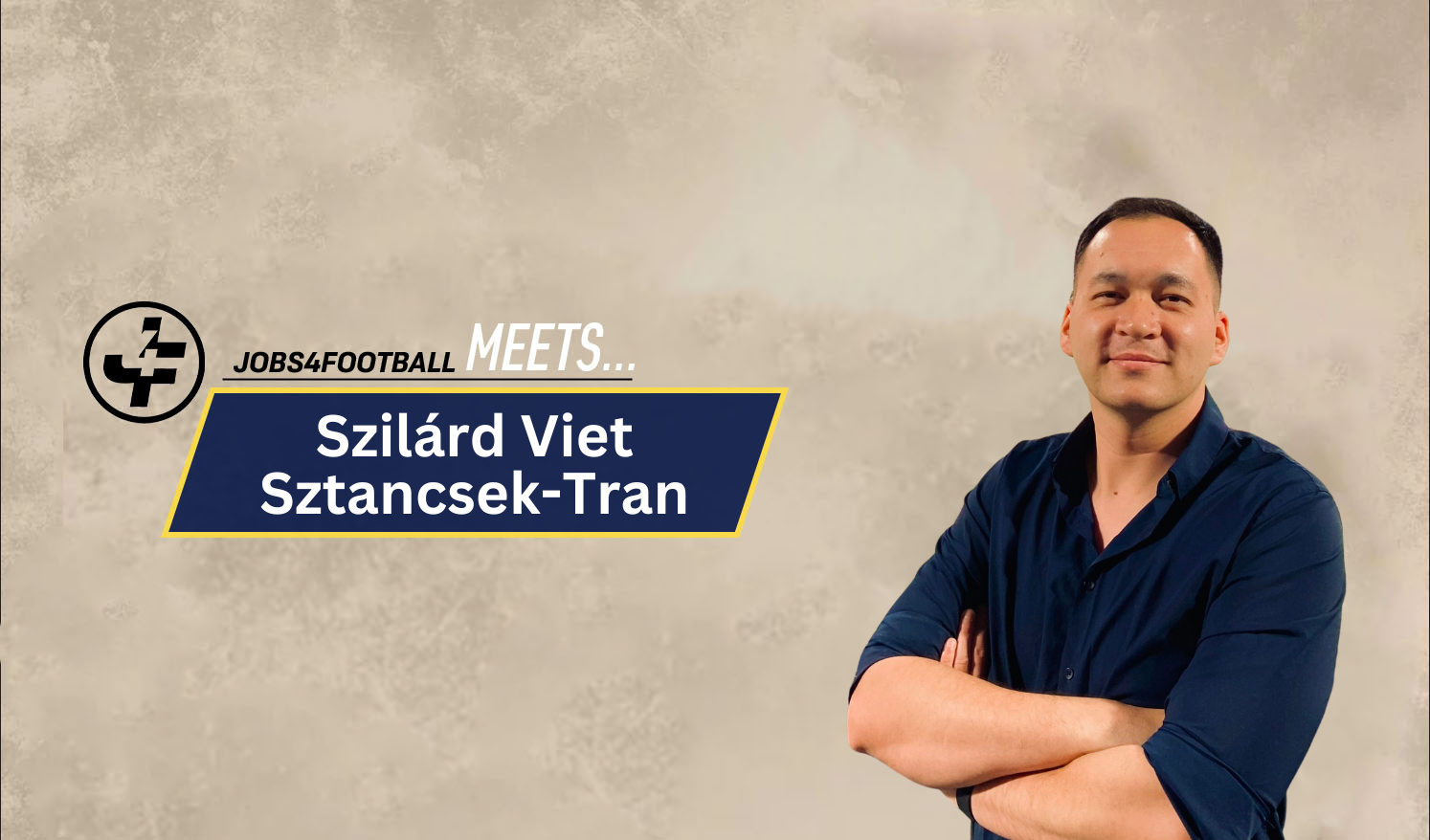
In this edition of Jobs4Football Meets, we sit down with Szilárd Viet Sztancsek-Tran, an international UEFA B-licensed coach and performance specialist with experience across Europe, Asia, and the Middle East.
With a background spanning elite youth football, senior environments, analysis, scouting, and set-piece strategy, Szilárd is now transitioning fully into senior football. This conversation explores his leadership philosophy, how he builds team identity under pressure, and what modern football demands beyond tactics.
From pressing principles and decision-making under pressure to cultural intelligence, language, and responsibility as a leader, this is an honest, football-led discussion about what it takes to lead in today’s game.
You’ve worked across multiple countries, age groups, and football cultures. When you arrive at a new club or team, how do you define and build a clear team identity, especially when results pressure appears early?
For me, team identity starts with behaviour, not words. I want opponents to feel uncomfortable with the ball against us. That comes from collective intensity, pressing, counter-pressing, and shared responsibility without the ball.
I strongly believe in pressing and gegenpressing principles. The exact structure always depends on the players available, but philosophically I’m close to the “heavy metal” idea — proactive, brave, aggressive football played with conviction. Players need to understand very quickly what we stand for and how we want to compete.
When results pressure appears early, simplicity and clarity are key. I don’t overload the team. I focus on principles that give confidence, energy, and control. If the identity is clear and the players believe in it, stability follows — and results usually come with it.
You’re now moving from elite youth environments into senior football. What are the biggest leadership and decision-making differences you’ve experienced or observed between youth and senior teams, and how are you adapting your approach?
In youth football, development is always the priority, even when you compete. In senior football, performance and responsibility come first — careers, contracts, and results matter immediately.
The biggest difference is communication. Senior players don’t need constant instruction; they need clarity, honesty, and trust. You must respect their experience while still setting non-negotiable standards.
I adapt by being more direct, more transparent, and more decisive. I still care deeply about development, but in senior football, development happens through winning habits, accountability, and clear roles.
Looking at your experience in competitive elite leagues and tournaments, how do you manage decision-making under pressure as a coach, both tactically and in terms of people management?
One of my strongest attributes during the game is reading the opponent very fast. I quickly understand what they want to do, where they want to hurt us, and how we can disrupt or destroy their game.
I’m not afraid to change immediately. I don’t wait for halftime just because it’s traditional. If I see something clearly, I act. That’s not reaction — it’s action. I take responsibility so the players don’t have to suffer for my ego.
In this sense, I’m very inspired by José Mourinho. His calmness under pressure, his anticipation of opponents, and his courage to make decisive changes are qualities I deeply respect and study.
Set-pieces are often described as “free goals,” yet many teams still under-invest in them. How do you structure your set-piece work so it becomes part of the team’s identity rather than a separate specialist add-on?
Set-pieces must be integrated into the weekly structure, not treated as something separate. They reflect the team’s mentality — discipline, timing, aggression, and focus.
I connect set-pieces to our overall principles: attacking with intent, defending with responsibility, and understanding space and roles. Players need to understand
why something works, not just where to stand.
When set-pieces are part of the identity, players take ownership. That’s when they become a consistent competitive advantage.
Based on your exposure to clubs and academies across Europe, Asia, and the Middle East, what do you believe modern senior football demands most from coaches today beyond tactics?
Beyond tactics, modern football demands leadership, emotional intelligence, and cultural understanding.
It’s essential to understand people. It doesn’t matter the color, background, appearance, or origin — I want players to feel that I’m one of them. I want to feel them, and I want them to feel me. We are humans, fighting for the same goals.
That’s why I’ve always been accepted wherever I’ve worked. I don’t arrive to dominate; I arrive to connect, build trust, and lead. Sir Alex Ferguson is a major reference here — his ability to manage people, cultures, and pressure over decades is something every coach can learn from.
You’ve worked extensively in analysis, scouting, and preparation roles alongside coaching. How has operating away from the touchline shaped the way you lead, communicate, and prepare teams on matchday?
Analysis has taught me one simple truth: you cannot give real feedback without evidence. Without video, you’re only suggesting situations, not explaining reality.
Video allows players to see exactly what happened. That creates clarity, trust, and learning. On matchday, it helps me stay calm and precise, because decisions are based on preparation, not emotion.
You’ve coached across different age groups, cultures, and competitive levels. How do you adapt your leadership style to different personalities while still maintaining discipline and standards?
Standards never change, but the way you reach people must adapt.
With younger players, training should be playful and imaginative. I want them to enjoy football, express themselves, and learn creatively. Discipline exists, but it’s built through engagement.
With senior players, leadership becomes more direct and accountable. When players feel respected and understood, discipline becomes natural.
Through your international experiences and current work in senior environments, what leadership or cultural insight has had the greatest impact on how you now lead and manage in senior football?
The biggest lesson is humility. You can’t lead people if you don’t respect where they come from.
Every culture has its own rhythm and communication style. When you take time to understand that, players give you everything. This has shaped me into a calmer, more adaptable leader who earns authority rather than imposing it.
You speak several languages at a high professional level. Beyond communication, how does this help you connect with players, staff, and decision-makers in high-pressure environments?
I currently know seven languages on different levels, and Spanish will be the eighth. I’m studying Spanish intensively and aim to reach
B2 level by the end of this year. After that, I want to learn Portuguese and, in the future, Arabic. My long-term goal is to be fluent in all of them.
Even when a language isn’t yet at a professional level in all of them, the effort itself matters. Language shows respect, reduces distance, and builds trust — especially in high-pressure environments.
If a sporting director or head coach in senior football were listening to this conversation, what would you want them to understand about your leadership philosophy and how it translates to winning environments?
I want them to understand that I take responsibility. I don’t hide behind systems or excuses.
Tactics matter, structure matters, and preparation matters — but football is also about people. I want to win, but I also want our football to be engaging and meaningful. Football belongs to the people, the spectators, the working class — everyone.
I’m pushing my pathway forward with full commitment. My goal is to obtain the UEFA A license as soon as possible. I was accepted before but missed out due to COVID; this year is about not missing the opportunity again. I’m even studying Spanish intensively to access the UEFA A pathway in Spain.
I’m open to different federations — including Spain, Malta, Ireland, Northern Ireland, Scotland, Hungary, and Qatar (AFC). I’m also building pathways for players to move beyond their own countries, especially toward emerging football markets like Saudi Arabia, the UAE, and Qatar. I’m building that future for them — and for myself.
This conversation reflects a coach who sees football as more than systems and sessions. Grounded in responsibility, cultural understanding, and clarity under pressure, Szilárd’s approach is shaped by experience across continents and environments, with a clear focus on senior football and modern leadership. As he continues his pathway toward the UEFA A licence and deeper involvement in international senior environments, his philosophy remains consistent: build trust, demand standards, and lead with conviction — on and off the pitch.