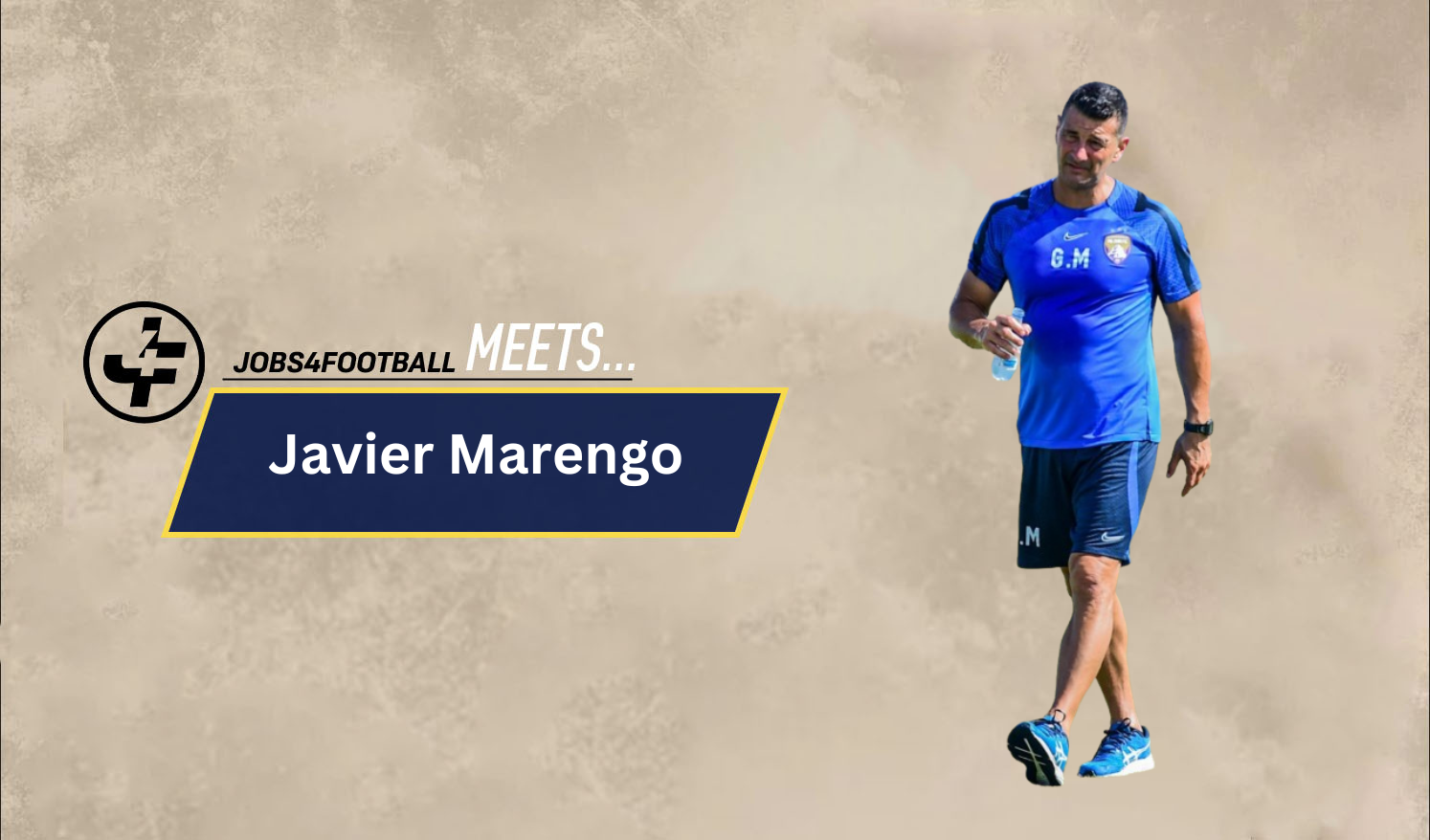
Jobs4football meets Javier Marengo
Few specialists can say they have led rehabilitation at a giant of Argentine football and then lifted the AFC Champions League in Asia before moving into bespoke high-performance work with a Champions League–level striker. Javier Marengo has done exactly that. With degrees in Athletic Training and Physiotherapy, plus a long spell heading the rehab and return-to-play process at Rosario Central’s first team, he built a reputation for blending science, field pragmatism and long-term athlete care at the highest level.
In this Jobs4Football Meets feature, he reflects on nearly a decade in Rosario, his move to Al Ain FC in the UAE, where he helped the club become champions of Asia in 2024and his current role as Performance Manager for Canadian international and Juventus forward Jonathan David. His journey offers a masterclass in how modern rehab and reconditioning can drive availability, performance and career longevity across continents. Let us delve into it:
Q: Your background is a rare blend of degrees in Athletic Training, Physiotherapy, and Physical Education. How did this multidisciplinary foundation shape your philosophy around rehabilitation, performance, and long-term athlete care in elite football?
A: My academic background in Athletic Training, Physiotherapy and Physical Education gave me a holistic view of the athlete from very early in my career. It allowed me to understand injury not as an isolated medical event, but as part of a broader performance ecosystem. Rehabilitation, performance and long-term athlete health are deeply interconnected, so my philosophy is built around restoring function while simultaneously rebuilding physical capacities and movement efficiency, always with the final game demands in mind
Q: You spent more than eight years at Rosario Central, leading rehabilitation and return-to-play work for the first team. What were the biggest lessons from managing injuries and reconditioning in such a historic and demanding Argentine club environment?
A: Working for more than eight years at Rosario Central was extremely formative. It taught me how to operate under constant pressure, emotional intensity and high expectations from fans, staff and players. One key lesson was the importance of communication and trust—between medical staff, coaches and players. Another was learning to individualize processes in an environment where competitive urgency is always present, without compromising player health or long-term performance
Q: At Rosario Central you were responsible not only for rehab, but also for redeveloping key physical qualities—strength, resistance, speed, coordination—before players returned to competition. Can you walk us through your typical process from day one of injury to the moment a player steps back onto the pitch?
A: My process starts on day one with a clear diagnosis and a shared plan involving medical staff, coaches and the player. Rehabilitation is progressive and integrated, moving from tissue healing and pain control to neuromuscular work, strength development, coordination and football-specific conditioning. The final phase focuses on restoring performance qualities—speed, power, resistance—and exposure to real game demands, ensuring the player returns not only symptom-free, but physically and mentally ready to compete
Q: Alongside your club work, you spent over a decade as an adjunct professor on the “Sports Physiotherapist” chair at Universidad del Gran Rosario. How has teaching influenced your daily practice with professional players, and what do you think young practitioners often underestimate about working in top-level football?
A: Teaching at Universidad del Gran Rosario had a strong influence on my daily practice. It forced me to constantly update my knowledge and critically reflect on what I was doing in the field. Young practitioners often underestimate how complex elite football environments are—technical knowledge is essential, but decision-making, communication, adaptability and collaboration are just as important to succeed at the top level.
Q: 2023 you made a major move, joining Al Ain FC in the UAE as part of the first-team rehabilitation department and helping the club go on to win the AFC Champions League in 2024. What were the key differences you noticed between Argentine and Emirati football in terms of injury profiles, training culture, and performance expectations?
A: Moving to Al Ain FC was both a professional and cultural learning experience. In Argentina, players tend to have higher exposure to repetitive overload and contact-related injuries, while in the UAE we saw more muscle-related injuries influenced by climate, travel and training rhythms. Training culture in the UAE is more structured and resource-rich, while performance expectations are extremely result-driven, especially in continental competitions.
Q:.Your role at Al Ain included designing and executing rehabilitation plans and injury-prevention programmes. What specific structures, methods, or innovations did you introduce there that you feel had the biggest impact on keeping players available and performing?
A: At Al Ain, I focused on creating structured rehabilitation pathways and integrated injury-prevention programs aligned with training load and match demands. We emphasized objective criteria for progression, GPS-based monitoring, and individualized conditioning strategies. The biggest impact came from improving communication across departments and aligning prevention, rehab and performance into one coherent process.
Q: More recently you have taken on the role of Performance Manager for Jonathan David, now at Juventus and a key player for the Canadian national team. How does working one-to-one with a world-class forward differ from operating inside a club environment, and what are your main priorities when building an individual performance and reconditioning plan at that level?
A: Working one-to-one with an elite player like Jonathan David is very different from a club environment. The focus becomes extremely personalized and strategic. My main priorities are availability, performance optimization and longevity. Every decision is tailored to his positional demands, competition calendar and individual profile, balancing performance gains with recovery and risk management.
Q: You have also invested heavily in continued education—postgraduate specializations in sports physiotherapy, manual therapy, dry needling, FMS/SFMA, GPS and training-load monitoring, and a Master in Football Injury Reconditioning. How do you integrate all these tools into a clear methodology rather than a collection of separate techniques?
A: For me, tools like FMS, SFMA, GPS, manual therapy or dry needling are not isolated techniques—they are parts of a unified methodology. The key is knowing when and why to use each one. Everything is driven by context, assessment and performance objectives. Technology and manual skills support decision-making, but the methodology remains simple, clear and athlete-centered.
Q: Having worked across South America, the Middle East, and now with a top European-based player, what do you see as the key trends shaping the future of rehabilitation and performance in elite football over the next five to ten years?
A: Over the next five to ten years, I see rehabilitation and performance becoming increasingly integrated. Data-informed decision-making, individualized load management and collaboration between departments will be central. There will also be a stronger emphasis on availability as a performance metric and on preparing players not just to return, but to sustain elite performance over longer careers.
Q: Looking ahead, with experience in big clubs, universities and now individual high-performance management, what would you like your next challenge to be? Are you aiming for a leadership role within a top club or national team structure, to expand your work with elite individuals, or to build a performance and reconditioning department of your own—and what kind of project would truly excite you at this stage of your career?
A: At this stage of my career, I am motivated by projects that allow me to build structures, lead teams and create long-term impact. Whether within a top club, a national team or my own performance and reconditioning department, I am excited by environments that value integration, innovation and athlete-centered performance, where the objective is sustainable excellence rather than short-term solutions, anywhere in the world.
Thank you, Javier, for opening a window into the realities of elite rehabilitation and performance—from the intensity of Argentina’s Primera División to title-winning nights in Asian competition and now tailored work with one of Europe’s top forwards. Your commitment to continuous learning and to building robust, intelligent return-to-play processes shines through every stage of your career.
As you look toward your next challenge, whether within a top club, national team, or leading a high-performance department, there is no doubt you will bring immense value to any organisation aiming to keep its best players fit, available and evolving season after season. Jobs4Football will be following your journey closely and looks forward to supporting that next step.