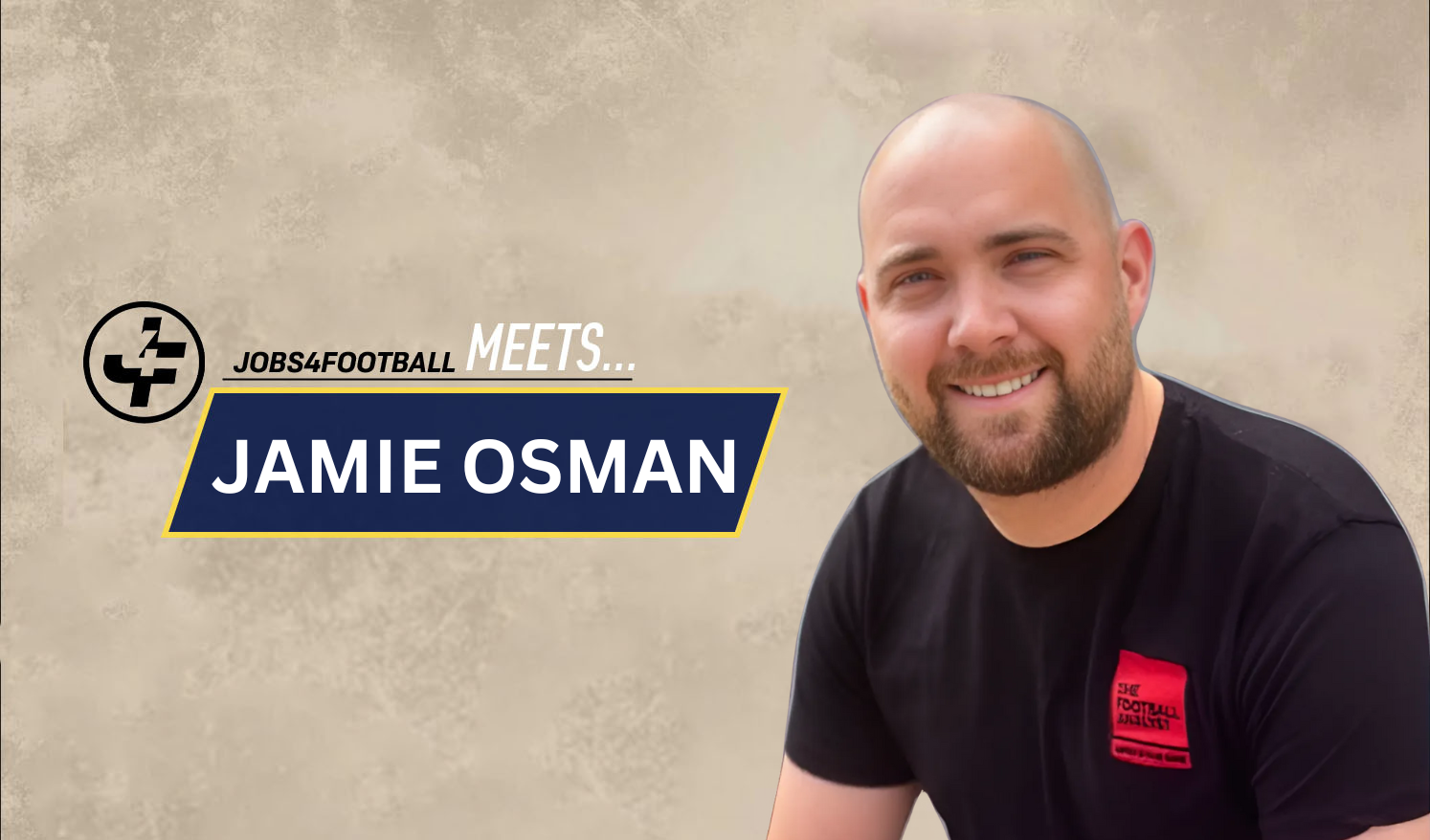
Jobs4Football Meets: Jamie Osman – From Premier League War-Room to Launching his Analysis Consultancy
Few analysts can claim to have shaped a club’s performance culture for more than a decade and then jumped straight into building a consultancy of their own. Jobs4football member
Jamie Osman did exactly that. After 13 transformative years at West Ham United and a season guiding Ipswich Town’s analysis team in the Premier League, he has launched The Football Analyst (
The Football Analyst | Expert Performance Analysis & Consultancy), a consultancy designed to audit departments, streamline workflows and deliver tailored performance insights for clubs, agencies and individual players.
Osman’s journey offers a blueprint for analysts looking to convert elite-club experience into entrepreneurial impact. With a
UEFA Europa Conference League medal in his drawer and a reputation for turning raw data into meaningful, coach-friendly narratives, he now supports organisations “work smarter, not harder” in a sport drowning in information overload.
Within this Q+A article, he reflects on the milestones that shaped his craft, the challenges of building club-wide analysis structures and the thinking behind his new venture. Enjoy!
You spent 13 years at West Ham United, progressing from academy roles to Head of Performance Analysis. Looking back, what were the pivotal moments or projects that shaped both your career and the club’s analysis culture?
I had an amazing time at
West Ham and feel incredibly fortunate to have worked alongside some brilliant people who taught me a great deal. Looking back, there were a couple of pivotal moments that really shaped my journey and helped influence the development of the club’s analysis culture.
The first came just six weeks after I joined, when I made the leap from the Academy to the First Team. At just 21 years old, I suddenly found myself traveling with the team—an incredible opportunity, but one I definitely had to grow into quickly. It was a steep learning curve, adapting to the fast-paced environment and the high expectations, but it helped me develop both personally and professionally. Sam Allardyce, who was a huge advocate for analysis and statistics, played a big role in that growth. He trusted our department with real responsibility and constantly challenged us to come up with fresh, creative ways of supporting the team—from new ways of visualising data to how we delivered key insights in meetings.
The second major turning point came when I was promoted to
Head of Analysis at 25. Taking on that level of responsibility at such a young age—leading a Premier League department—was both exciting and daunting. I leaned heavily on what I’d learned from my own manager and other Heads of Department at the club, especially around leadership, communication, and navigating the internal workings of a football club—from reviews and budgets to managing up and down and dealing with the inevitable politics. One of the most important lessons was learning how to tailor our support to different personalities—some coaches and players wanted data, others preferred short video clips or conversation. Knowing your audience was key.
Over the next eight years, we worked hard to evolve the department’s structure and impact. We introduced more specialised roles, built workflows around each analyst’s strengths, and used technology more intelligently to scale our insights. We also put a lot of focus on analyst development—mentoring staff, offering clear progression pathways, and creating an environment where they could have a voice and grow. That, in turn, led to better output for coaches and more consistency for players as they progressed through the club. Seeing that long-term impact—from the training ground to match day—was one of the most rewarding parts of the role.
When you first assumed overall responsibility for West Ham’s analysis department, how did you structure workflows across the men’s, women’s and academy teams to ensure consistency and clear information flow?
While my primary focus was on the
men’s first team, I also had overall responsibility for the analysis budgets across the entire club—including the women’s and academy departments. Managing this wasn’t without its challenges, especially as each department operated from different sites, and my day-to-day role was heavily geared towards opposition analysis at the senior level.
As my role evolved, I stepped into a position that allowed me to oversee analysis across the club more holistically. One of our key priorities was to bring a level of consistency to how analysis was delivered, even though workflows couldn’t be completely identical across departments. We focused on aligning the software tools and processes we used—ensuring there was a shared language and methodology in how we analysed matches and delivered feedback.
This consistency became especially important for
player development. We wanted to make sure that as players moved up from the academy into the first team, they encountered a familiar analysis environment. That continuity helped smooth their transition and supported better long-term development.
Equally, we saw value in creating clear pathways for our analysts. By aligning systems and workflows across departments, it became much easier for staff to step up when opportunities arose—whether that was moving from the academy or women’s teams into the men’s first team environment. From both a performance and business perspective, this approach not only improved internal development but also helped the club become more efficient and cost-effective in the long run.
West Ham’s 2023 UEFA Europa Conference League victory was historic for the club. From an analyst’s perspective, how did your department’s work influence preparation and in-game adjustments during that run?
The build-up to the
Europa Conference League final was intense. With the match taking place in early June—much later than a typical season—we had a couple of weeks to really focus our efforts, and we brought nearly every analyst into the fold.
From a preparation standpoint, we left no stone unturned. We covered everything: tactical strengths and weaknesses, potential formation changes, likely personnel rotations, and a deep dive into their set-piece routines. For every player eligible to feature in the final, we created detailed profiles—where they came from, their career paths, tendencies in and out of possession, and key behavioural patterns. Each profile was paired with short video clips to help bring those insights to life for the players and coaches.
We also tried to bring something a bit different to the table.
Charlie Radmore, one of our analysts, put together a motivational video that included every player in the squad. It closed with surprise video messages from their families, which added a personal and emotional touch we felt could give the team an extra boost on the day.
Ultimately, it was a real team effort from the analysis department—blending data, video, and psychology—to support the players and coaches in the best way possible. To see all of that work contribute to such a historic night for the club was incredibly rewarding.
Moving to Ipswich Town ahead of their Premier League campaign required you to build processes almost from scratch. What were the first 90-day priorities for implementing a top-flight analysis operation, and how did you measure success?
Not quite! When I arrived at
Ipswich, the club was coming off the back of two consecutive promotions and had already built a fantastic culture, including a really strong team of analysts. I wasn’t starting from scratch—instead, I was brought in to manage the team, refine workflows, and bring my experience from the Premier League to help the department continue evolving at the top-flight level.
My first priority was to observe and understand. I wanted to get a clear picture of how the existing workflows operated—why things were done a certain way, what was working well, and where there might be room to improve or increase efficiency. We very quickly got into a rhythm, defining clear job roles within the team that aligned with each analyst’s strengths. That clarity helped us deliver more consistent output while also allowing individuals to really excel in their specific areas.
Measuring success in analysis is always a challenge. Just because you win a match doesn’t necessarily mean the analysis department has done a great job—and the same goes for losses. For me, the key question is:
can we confidently say that we’ve done everything possible to give the coaches and players what they need to prepare effectively? If the answer is yes, then I feel we’ve done our job.
That said, as an analyst, you’re rarely fully
"in the green." You’re constantly walking a fine line—you’re either delivering exactly what’s needed, or you’ve missed something. That constant pressure is part of the role, but it’s also what keeps us pushing to improve every single day.
Implementing data-driven decision-making can meet resistance. Could you share a specific challenge you faced—either at West Ham or Ipswich—and the strategy you used to win buy-in from coaching staff or players?
Implementing data-driven decision-making always requires a collaborative approach—both in how you present information and how you build relationships. Whether at West Ham or Ipswich, we found the most effective strategy was combining data and video to tell a clear, consistent story. It’s rarely about presenting raw numbers in isolation; it’s about using data to support what coaches and players can see on screen and feel on the pitch.
At both clubs, our department adopted a two-pronged approach: using video to highlight tactical points and pairing it with data that backed up those insights. This helped ensure that our messaging was aligned, digestible, and—most importantly—relevant to the team’s strategy and the manager’s philosophy.
Collaboration between analysts and coaches is absolutely essential. You have to build trust and foster open communication. That doesn’t mean there aren’t disagreements—in fact, healthy debate can often lead to better outcomes. But at the end of the day, our role as analysts is to adapt to what the manager needs, while still offering our own perspective and ideas where appropriate.
Ultimately, success in this space comes from alignment. Everyone—analysts, coaches, and players—has to be pulling in the same direction. When that happens, data becomes a tool to enhance decision-making, not replace it.
Conversely, what is the most rewarding example where analysis directly translated into on-pitch improvement or player development, and what made that collaboration successful?
Ultimately, the most rewarding examples of analysis making a real impact on the pitch always come down to one thing:
player buy-in. As analysts, we can produce all the information in the world—we can give coaches and the manager detailed reports, stats, video breakdowns, and tactical insights, and more often than not, they understand and value what we bring. But with players, it's different. Every individual is unique in how they learn, how they prepare, and how much they want to engage with analysis. Some are naturally curious, always looking for that extra edge, while others prefer to keep things simple and focus more on feel and instinct. And that’s completely fair—there’s no one-size-fits-all.
That’s why one of the most satisfying moments for me was working with a player who initially wasn’t overly engaged with analysis. He was talented, hard-working, and professional, but not someone who typically asked for clips or data. Over time, through casual conversations, one-to-one feedback sessions, and by tailoring how we delivered information—shorter clips, more visual cues, less data-heavy documents—we slowly built trust. We focused on showing him specific moments that were directly relevant to his game: positioning in transition, body shape when receiving, or how certain patterns kept repeating in matches.
What changed everything was when he started seeing the results himself—whether it was improved positioning, fewer turnovers, or simply being in better places to affect the game. Once that connection clicked—that what we were showing him actually worked—it opened the door. He started asking for clips before games, reviewing his own performance after matches, and even looking at upcoming opponents on his own time.
That kind of shift is hugely rewarding, not just because of the individual improvement, but because it shows the power of
tailored, collaborative analysis. It wasn’t about overwhelming him with data or forcing a particular method; it was about understanding what would resonate, and building that relationship over time.
In the end, when players feel that the information they’re being given genuinely helps them perform better, that’s when analysis moves from being a background tool to something that drives real development—and that’s what makes the job so worthwhile.
You’ve now founded The Football Analyst consultancy to audit club analysis departments, provide recruitment support and deliver bespoke player insights. What unmet needs in the football industry convinced you to take this entrepreneurial step?
After spending so many years working inside club football, I’ve had a front-row seat to the evolution of analysis and how rapidly the expectations around it have grown. Departments are now expected to cover more ground than ever—opposition reports, player development, data integration, live coding, post-match reviews, recruitment support—and often with limited time, resources, or personnel.
One thing that always stood out to me was the sheer amount of work analysts put in. Most go well beyond the typical ‘working hours’—often taking work home, watching clips late at night, and constantly thinking about how to improve things. It becomes second nature. But that same dedication also highlights a real issue: there’s only so much time in the day, and as much as analysts and departments want to provide detailed insights for every player, it’s just not always possible within the club environment.
That’s what inspired me to set up
The Football Analyst. I saw a clear gap where we could support not just clubs, but also players, agencies, and organisations by offering tailored analysis that’s both specific and actionable. Whether it’s giving a player deeper insight into their own game, preparing for a specific opponent, helping clubs audit their analysis processes, or supporting recruitment decisions—we wanted to offer something that could bring real value without adding extra pressure to already overstretched departments.
What’s most important for us is that everything we provide is built on understanding the needs of the modern game—from both the technical and human side. We’re not here to overwhelm people with data, but to translate insights into something usable and meaningful. We believe that, whether it’s on the pitch or behind the scenes, there are always opportunities to gain a competitive edge—and that’s what we’re here to deliver.
For clubs or agencies considering a consultancy partnership, what are three quick-win improvements you typically identify during your initial audit, and how do these set the foundation for longer-term competitive advantage?
When we begin working with a club, agency or organisation, one of the first things we focus on during our initial audit is identifying simple, actionable improvements that can have an immediate impact. While every environment is different, there are three common areas where we tend to find quick wins that lay the foundation for long-term competitive advantage:
- Clearer Prioritisation
One of the most common challenges we see is that analysis departments often try to cover everything. That’s a natural instinct—analysts want to be thorough and prepared for any question that might come their way. But in reality, this approach can dilute focus and stretch resources. We help departments reassess what’s truly important: What are the manager’s non-negotiables? What tactical elements consistently impact performance? What’s noise, and what’s genuinely useful? By tightening that focus, teams become more strategic in their output—and far more effective.
- Workflow Efficiency
Even small inefficiencies in daily processes—how data is collected, how video is tagged, how reports are distributed—can add up to significant time lost. We work with departments to map out their current workflows and identify bottlenecks or duplication of effort. Often, with just a few tweaks—such as reassigning roles based on strengths or automating routine tasks—we can improve turnaround times and free up more space for meaningful analysis. It’s not about working harder, it’s about working smarter.
- Budget and Software Utilisation
Every club or organisation has a different level of access to tools, software, and budget—but not everyone is making the most of what they have. We look closely at how current resources are being used and whether they align with the department’s priorities. In some cases, it’s about streamlining overlapping tools to improve integration and clarity; in others, it’s about identifying more cost-effective platforms that deliver equal or better performance. The aim is to ensure that every investment directly supports meaningful analysis and decision-making.
Ultimately, these early improvements are about creating clarity and direction. Once those foundations are in place, it becomes much easier to build a sustainable, high-performing analysis setup—one that serves coaches, supports players, and drives competitive advantage over the long term
Thank you, Jamie, for opening the doors to your 13-year Premier League war-room experience and for generously unpacking the lessons that now drive
The Football Analyst. Your candour about building club-wide structures, nurturing analyst development and translating data into coach-friendly narratives enriched this piece beyond expectation. As you pivot from club corridors to the wider football ecosystem, we are excited to see your audit-led approach streamline workflows, sharpen recruitment and empower decision-makers from academies /clubs to investors and media. The promise of helping organisations
“work smarter, not harder” resonates across continents and competitions, and we are confident your consultancy will become a trusted catalyst for sustainable competitive advantage.
Jobs4Football will be cheering every milestone along the way and looks forward to the future collaborations we have planned as your vision takes shape.