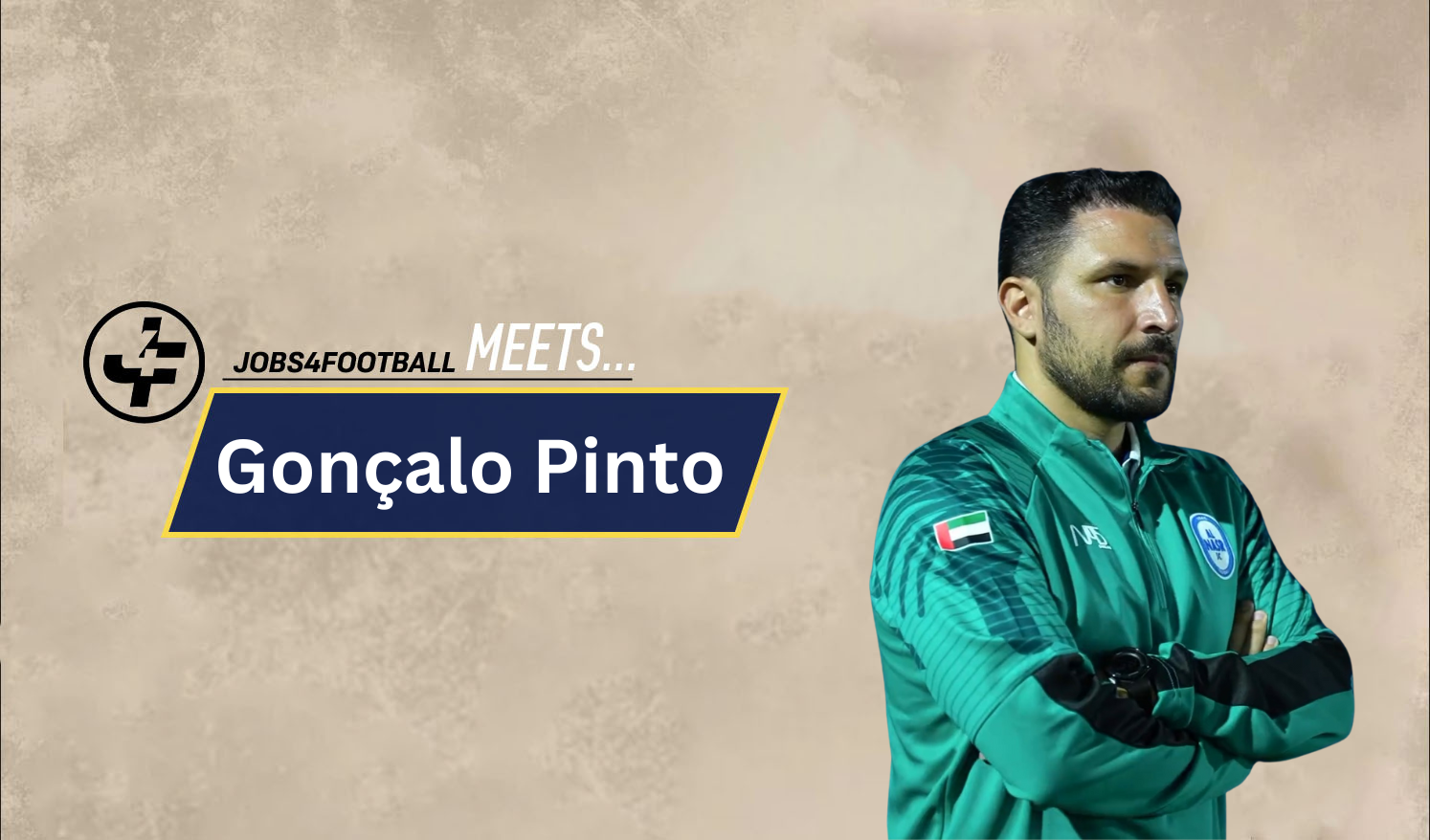
Gonçalo Pinto is a dynamic and accomplished football coach whose international experience spans five countries, shaping a coaching philosophy that blends tactical acumen with cultural adaptability. With a BSc in Sports Coaching from Portugal and both UEFA A and AFC A Licenses, Pinto has honed his skills across diverse football landscapes, from youth development to professional academies.
His journey has taken him from the technical rigors of Portuguese football to the cultural complexities of South Africa and Canada, and on to the results-driven environments of Finland and the UAE. As the former Head Coach of the Academy at Al Nasr SC, Pinto achieved remarkable success, including a 47% increase in points per round with the U14 team and boosting the number of players called up to the UAE National Team.
In this interview with Jobs4football, Gonçalo shares his insights on international coaching, youth development, and the art of balancing player growth with competitive success. From creating comprehensive coach education programs to preparing players for international competition, Pinto offers a wealth of knowledge that showcases why he is a rising star in the world of football coaching.
You've coached in diverse countries like Portugal, South Africa, Canada, Finland, and the UAE. How has this international experience shaped your coaching philosophy?
Coaching across five different countries has been instrumental in shaping my coaching philosophy. Each environment presented unique challenges and strengths, pushing me to constantly adapt and grow.
In Portugal, completing my BSc in Sports Coaching with a specialization in football was crucial in building a strong foundation. Subjects like Theory and Methodology of Training, Tactical Periodization, Physiology, and Performance Analysis were all football-specific, providing me with invaluable knowledge.
At the same time, coaching youth teams from U8 to U15 allowed me to apply this theoretical understanding in real-world scenarios, bridging the gap between classroom learning and practical coaching.
In South Africa and Canada, I gained a deeper appreciation for the importance of cultural contexts and individual player mindsets.
My time with Vancouver Whitecaps FC was particularly eye-opening. Their distinct philosophy and methodology taught me the value of adapting to a club’s system, while still contributing my own insights to strike a balance between structure and innovation.
In Finland and the UAE, I learned how to balance a results-driven approach with long-term player development, refining my ability to adapt to different football cultures and priorities.
This international exposure has ingrained in me the importance of developing adaptable players - those who can think critically and apply themselves both on the field and in life.
My coaching philosophy has evolved through these experiences, allowing me to filter what works best based on the cultural and football context.
In the end, I believe "Good coaching means purposeful practice and quality feedback."
It’s about understanding the environment, shaping the right approach, and focusing on growth both individually and collectively.
As Head Coach of the Academy at Al Nasr SC, you achieved impressive results with the U14 team. Can you share a specific strategy that contributed to the 47% increase in points per round?
Honestly, it was quite a shock when I first started with the team, especially coming from Europe, where I had just won the league in Finland with IF Gnistan's U17s.
The environment was very different, and the training intensity was much lower than what I was used to. Implementing high intensity training habits and creating a culture of excellence took time, but it was essential for raising the level of performance.
Early on, we identified that a lot of goals were being conceded due to a lack of understanding of basic defensive principles. To address this, we began by focusing on individual defensive skills, gradually building into small group work, sector-based training, and eventually inter-sectorial work.
One key shift was moving towards a player-centric approach, breaking away from traditional "one-size-fits-all" drills. Our training sessions became much more dynamic, emphasizing adaptability, decision-making, and high-intensity defensive work, including defensive recovery.
Once we resolved our short-term defensive issues, we shifted focus to the attacking side, working to enhance the players' confidence in 1v1 situations, improving their game intelligence, and exploring space in the creation phase of play.
To reinforce these concepts, we integrated game scenarios that mirrored real match conditions, helping players develop the ability to think faster under pressure.
Additionally, we held classroom sessions where we dissected our Game Model visually, ensuring the players understood their roles and responsibilities in all moments of the game.
The results spoke for themselves - through improved teamwork, tactical understanding, and execution, we achieved a 47% increase in points per round.
You've successfully coached both male and female teams. How do you adjust your approach when switching between genders in football?
To start, I want to quote Gregg Popovich -
“Relationships with people are what it’s all about. You have to make players realize you care about them”
When coaching male and female teams, I believe the main differences rely on the social dynamics and communication strategies having to vary significantly.
Research has highlighted that girls prioritize social belonging more than boys, with studies showing that girls are more affected by peer rejection and thrive in environments that emphasize relationships and collaboration. As a result, in women’s teams, relationships are often the foundation for performance, where creating a strong sense of trust and belonging directly impacts their engagement on the field.
For female players, social connections within the team are essential, and fostering friendships can be a strong motivator for remaining committed. By emphasizing collaboration and providing rationale for tactical decisions, I create a space where female athletes feel more included and motivated.
In contrast, boys often focus on performance first, placing a higher emphasis on competitiveness and direct feedback. My approach with male teams tends to be more focused on driving intensity and competition, with clear, assertive communication, helping them thrive in high-pressure situations.
In both cases, my aim is to tailor training to their distinct needs - understanding that female players benefit more from an inclusive approach, while male players may respond better to a more performance-driven style.
By recognizing these differences, I can create environments where athletes feel understood and supported, which in turn leads to better on-field performance.
At Vancouver Whitecaps FC, you created a comprehensive coach education program. What key elements did you include, and how did it impact the club's overall performance?
At Vancouver Whitecaps FC, I started by observing and conducting one-on-one meetings with all the coaches. It became clear that the club lacked leadership and direction.
However, I saw the potential for a team of strong-minded individuals who, with the right guidance and a shared vision, could drive collective progress week by week.
To address this, I introduced monthly coaching development sessions. These sessions were simple at the start, focusing on presenting our values, mission, and guiding principles. From there, we built a clear methodology and philosophy, aiming to align everyone with a unified approach to player development.
I structured the program around four key pillars: technical leadership, communication, grassroots development, and the competitive program. These pillars laid the foundation for our ‘one vision’.
One of the fundamental concepts I introduced was to move away from isolated skill development.
Instead, we focused on integrating perception, decision-making, and execution in all training sessions, incorporating constraints like time, space, and pressure to simulate real-game conditions. Increasing player contact time with the ball was a priority across all age groups.
During our sessions, I also challenged the coaches by asking them to describe the worst possible training session—one where kids were standing in lines, receiving harsh criticism, and having minimal engagement. Once we defined what to avoid, we shifted to discussing what the best training session looked like: small-sided games, high energy, active involvement, positive reinforcement, and fun. This exercise helped set the standard for how we approached player development.
Our training sessions followed a consistent structure: greeting the players upon arrival, starting with a technical warm-up, moving into a discovery game, followed by tactical or technical drills, and ending with match play. Every session concluded with a debrief and cooldown, allowing coaches to ask players reflective questions about their performance and outcomes.
Through monthly coaching development meetings, we emphasized the importance of continuous learning, collaboration, and avoiding isolated practices. Coaches were encouraged to observe each other’s sessions and share best practices. By fostering a growth mindset and focusing on both the technical and emotional development of the players, the program unified the coaching approach across all age groups. This resulted in greater consistency in training and a noticeable improvement in the club’s overall performance.
With your experience as a Technical Director, how do you balance the demands of player development with the pressure to achieve results in competitive leagues?
Balancing player development with the pressure for immediate results is a constant challenge, especially for clubs that lack a clear vision.
The key question is: "What kind of results are we striving for?" Is it purely the outcome of a match, or is it about the players' progress—how they apply what they’ve learned, practice by practice?
For me, player development and results go hand in hand, but I define results differently. Rather than focusing on match scores, I emphasize performance. I never ask, "What was the result of X game?" Instead, I want to know, "How did the players perform? Were they able to apply the concepts we've been working on in training?"
For example, if the theme of the week was "switching the point of attack," during the game, I measure success by how many times the team successfully executed that concept. I track key performance indicators (KPIs) like these, rather than focusing on the final scoreline.
As a Technical Director, I make it a point to attend most games across all age groups, from U9 to U19, to provide real-time support for coaches and feedback for players.
This presence is crucial for reinforcing the club’s philosophy and ensuring alignment with our long-term vision. My goal is to get complete buy-in from the coaching staff and to prioritize player growth, both technically and mentally, above short-term outcomes.
In summary, while balancing player development with competitive results is always a challenge, my focus remains on establishing a long-term vision where performance, growth, and learning are the primary metrics for success.
You've worked with youth teams across various age groups. How do you tailor your coaching methods for different developmental stages?
Coaching youth teams across various developmental stages is a complex and demanding task that requires coaches to continuously adapt their feedback, demeanor, and interaction style. This becomes even more challenging when factoring in differences in gender, cultural backgrounds, and the intricacies that arise from working in different countries. It is essential to deeply understand both football fundamentals and the broader cognitive, emotional, and physical development of children.
At the heart of my coaching philosophy is a commitment to focusing on the
child behind the player - ensuring that each individual's needs are recognized and addressed throughout their development, not just as footballers, but as people.
Consider these common questions:
- "Why don’t they pass to their teammates?"
- "Why do they chase the ball all over the field?"
- "Why don’t they play in their positions or spread out?"
- "Why don’t they do something 'significant' with the ball, as parents often expect?"
Experienced coaches and Technical Directors have undoubtedly heard these concerns from parents and coaches. To address these questions, we must first dig into the
why - only then can we tailor coaching methods for different developmental stages effectively.
The first step is acknowledging that children progress through distinct developmental stages, as explained by Jean Piaget’s theory of cognitive development. For younger players (ages 6–11), they are often in the pre-operational or concrete operational stages. During this period, children learn best through direct, hands-on experiences. My approach here is to make training sessions fun and engaging, fostering a love for the game while focusing on basic technical skills such as ball control and dribbling. At this stage, players are more focused on themselves rather than understanding team tactics, so we keep the sessions simple but impactful. To encourage problem-solving, I create game scenarios where they must make decisions, which supports their cognitive development as well as their physical growth.
As players transition into the 12–14 age group, they enter the formal operational stage, where they begin thinking more abstractly. Here, I introduce more complex tactical concepts, emphasizing team dynamics while continuing to develop their technical abilities. Cognitive development is key at this stage, so I design training sessions that encourage creative thinking, problem-solving, and decision-making under pressure. Game-like situations with specific constraints (like space, time, and pressure) challenge their understanding of the game, enabling them to apply these concepts in real match scenarios. At this stage, we also start focusing more on collaboration and communication, helping players understand their roles within the team and making them more aware of how to contribute to team success.
For older youth players (ages 15+), training shifts towards preparing them for the demands of competitive football. My focus here is on developing mental resilience, leadership skills, and self-reflection. As these players become more self-aware, I use methods that encourage critical thinking about their performances. Sessions are more intense, designed to challenge them both mentally and physically, and they increasingly mimic real game conditions. Tactical drills, designed for fast-paced decision-making, help players deal with pressure and learn how to stay composed under difficult circumstances. Fostering emotional intelligence is essential at this stage, as it helps players handle setbacks, deal with pressure, and thrive in competitive environments.
Ultimately, my goal across all age groups is to develop not only great footballers but also well-rounded individuals who are confident, resilient, and equipped with life skills that go far beyond the football pitch.
Your achievements at Al Nasr SC include increasing the number of players called to the UAE National Team. What specific aspects of player development do you focus on to prepare them for international competition?
To prepare players for the international stage, we implement a comprehensive approach that focuses on building a solid technical foundation while fostering tactical flexibility, ensuring players can adapt to various systems and styles of play.
Mental resilience is equally crucial. International competitions present high-pressure environments, so we emphasize mental conditioning to help players handle setbacks, maintain focus, and stay composed under stress.
A key part of our strategy was the introduction of Individual Development Plans (IDPs), tailored to each player's strengths and areas for improvement. These plans encompass four pillars: technical, tactical, physical, and psychosocial, ensuring holistic development.
Additionally, our training program emphasized In Possession and Out of Possession player tasks.
Asking for feedback from players once they come from the National Team setup is crucial to adapt their IDP’s and to bring a new focus on aspects to improve. As well as NT staff if we get that chance.
Practical Example:
Technical Pillar: We focus on enhancing skills such as dribbling and running with the ball, while targeting specific areas like attacking space with the first touch or improving crossing techniques. Functional training sessions, held twice a week, provide players with the repetition and guidance needed to master these technical aspects.
Tactical Pillar: Players are taught to be aggressive in 1v1 situations to deny opponents or recover the ball, but we also focus on improving their game intelligence. We work on increasing their awareness of spaces both in front and behind and teach them to better recognize visual cues to press more aggressively or provide cover. Video analysis sessions are integrated to reinforce these concepts.
Physical Pillar: Strength and conditioning play a vital role in player development. We prioritize acceleration, coordination, and balance while targeting endurance and power through gym sessions. This ensures that players are physically prepared for the intensity of international competition.
Psychosocial Pillar: Developing a proactive mindset is critical, whether in attacking or defending. Players are encouraged to develop confidence and self-belief by watching their favorite players and observing how they carry themselves on the field. We work on fostering an attacking mentality, even from defensive positions, focusing on timing, positioning, and desire.
This holistic development approach, centred around individual responsibility, team synergy, and consistent evaluation, resulted in players stepping up their performance and gaining the attention of national team scouts.
As someone with both UEFA A and AFC A Licenses, how do you integrate different coaching philosophies from various football cultures into your work?
My understanding of various football cultures has been further enhanced by my international coaching experience in nations such as Portugal, South Africa, Canada, Finland, and the UAE.
In Portugal, I earned my BSc in Sports Coaching with a specialization in football, where I also developed a strong foundation in tactical and technical training aligned with the UEFA philosophy.
This exceptional opportunity to immerse myself in a variety of coaching philosophies from diverse football cultures has greatly shaped the way I approach coaching. From the UEFA A License, I’ve learned the value of rigorous planning and a methodical approach to training, with a strong emphasis on tactical discipline and structured methodologies. The European model stresses tactical periodization, emphasizing the need to segment the game into distinct phases to equip players for the intricacies of elite competition.
Conversely, the AFC A License has introduced me to a more adaptable, player-focused methodology often observed in Asian football. Here, the emphasis is on flexibility, originality, and developing each person’s potential within a larger team framework. Players are encouraged to think quickly, adjust to the game’s flow, and express themselves creatively on the field.
In South Africa and Canada, I discovered how crucial it is to comprehend cultural context and adapt my coaching approach to fit each player's specific needs. Finland and the United Arab Emirates offered valuable perspectives on striking a balance between a results-oriented mindset and the long-term development of players.
By combining these distinct methodologies, I have formulated a coaching philosophy that fuses the tactical discipline of European football with the adaptability and flexibility commonly seen in Asian and other global football environments. This enables me to design a balanced, comprehensive curriculum that prioritizes personal development, creativity, and mental toughness, alongside achieving game results.
Ultimately, my goal is to ensure players are technically sound, tactically astute, and flexible enough to succeed in a range of competitive settings, regardless of the style of play they encounter.
Looking at your career progression, what's been the most valuable lesson you've learned about leadership in football, and how has it influenced your coaching style?
Leadership isn’t just about dictating strategy; it’s about listening, creating mutual respect, and fostering ownership within the team.
“Valuable Lesson?” - The importance of adaptability, understanding the unique context of both the players and the environment, and the need for empathy, communication, and active listening.
This approach has shaped my coaching style to be more inclusive and collaborative, ensuring that everyone feels empowered to contribute to the team’s success. Coaching across diverse countries like Portugal, South Africa, Canada, Finland, and the UAE, I’ve learned that leadership in football is never a one-size-fits-all approach. Each culture, team, player, and staff member require a tailored style of leadership.
In Portugal, where I built my technical foundation through my BSc in Sports Coaching, I learned the value of rigorous planning and tactical periodization. The leadership style there required discipline and structure, giving me the tools to lead with precision and vision.
South Africa and Canada taught me the importance of cultural sensitivity. Understanding cultural contexts, player mindsets, and socio-economic backgrounds was key to building trust. Leadership in these environments involved being both a coach and a mentor, adjusting feedback and communication to individual needs.
In Finland and the UAE, I learned how to balance the immediate pressure of results with the long-term vision of player development. Managing expectations from players and clubs, I fostered a winning mentality while nurturing a development-first culture. This balance became a cornerstone of my coaching, helping shape players who can succeed in both the short and long term.
True leadership is about empowering both players and staff to take responsibility for their development, helping them become more self-aware and proactive.
Ultimately, adaptability, cultural understanding, and a long-term vision are the leadership qualities that have defined my coaching style.
I aim to create an environment where players are not only technically and tactically prepared but also mentally resilient, adaptable, and confident on and off the field. This holistic leadership approach continues to influence the impact I have on teams and players.