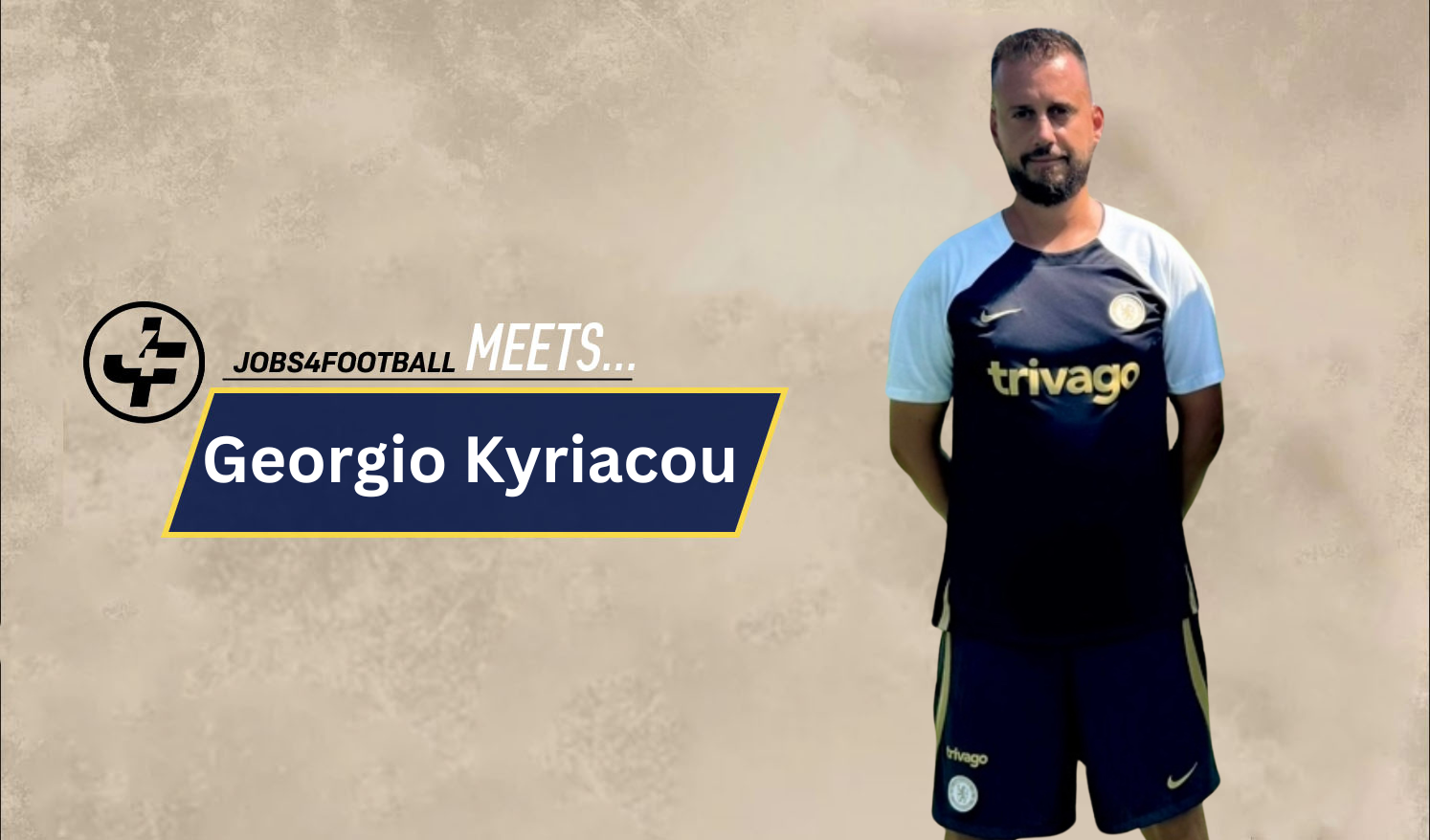
Jobs4football Meets... Georgio Kyriacou
Transitioning from a professional playing career to coaching is a journey marked by personal growth, adaptation, and a deep love for the game. Georgio Kyriacou's story reflects this evolution beautifully. Starting with a youth career that saw him represent county and regional teams, Georgio's playing journey spanned continents, from trials at Norwich City to stints in the USA, Guatemala, and Spain. Each chapter of his playing career introduced him to diverse footballing cultures, from the high expectations of Central American top-flight football to the technical emphasis of Spanish leagues under coaches like Javi Moreno.
Despite setbacks, including a series of injuries that led him to retire from playing, Georgio’s passion for football remained undiminished. Coaching became a natural transition, beginning during his time in the USA and growing into a career focused on nurturing talent and imparting the wealth of knowledge he accumulated over the years.
In this interview, we explore how Georgio's international experiences shaped his coaching philosophy and what motivated his move into coaching. We delve into the challenges and rewards of working across different footballing cultures, from the fast-paced, physical game in the USA to the possession-oriented style in Spain.
Georgio also shares insights into how he leverages his experiences to mentor young players, tailoring sessions to diverse skill levels and backgrounds while maintaining high standards of professionalism and safeguarding. His story is not just one of personal resilience but a testament to the transformative power of football to inspire and connect, whether on the pitch or from the sidelines.
Can you share your journey from playing at a professional level to transitioning into coaching? What motivated this shift?
I played for my county and regional team as a youth player and spent time at Norwich City on trial. I joined a full time football and education program at North Hertfordshire College where I played for Stevenage FC and Hitchin Town FC for two years whilst studying. Following that, I continued to pursue my playing career and spent time in the USA with USL sides Ventura County Fusion in California and Seattle Sounders U23. Living and playing in the USA at a young age was a great life experience and one I enjoyed a lot.
I was taken to Deportivo Coatepeque CF in the Guatemala top division “Liga Nacional” by an American Head Coach who was appointed to get the team back on track. It took some time to adapt because of the language barrier and the cultural change but the area of Guatemala we were in was near the Mexican border and the people were really nice. The club had a fan base of over 20,000 fans so expectations were high. The level in training was top and the team was full of internationally capped players in Central and South America. It didn’t turn out to be a long term move for various reasons and my next stop was in Spain where I spent time at CD Torrevieja CF and Novelda CF where I was coached by Javi Moreno the ex-AC Milan and Spanish National Team forward.
As a technical and creative player, this is where I really enjoyed my football and loved the training sessions designed by Javi which were short, intense and based on different rondos and possession games followed by small sided games. I fractured my ankle half-way through the season and I struggled to return to full health suffering repeated impact injuries in the same area and I started to have pain in other areas like my knee and hip. After trying to return to fitness and suffering various knockbacks and being of a certain age, I reluctantly decided to stop playing and started to pursue my coaching career.
I actually started coaching when I was in the USA with Ventura County Fusion, spending time on my days off assisting and coaching in the grassroots and academy programs so it was a natural transition. I realised I had picked up a lot of football knowledge and details over the years so it was just a matter of developing my skillset and coaching toolbox to be able to make the transition.
Your playing and coaching experience spans various countries, including the UK, the USA, Cyprus, and Spain. How has working in different football cultures influenced your coaching philosophy?
It has definitely played a big role, not so much in terms of my game model or philosophy which I think has to be adaptable depending on where you are working and the level however it has given me a good understanding of the differences between different football cultures and environments. As an example, the game in the USA is much more vertical and athleticism is prioritised whereas in Spain it’s obviously more possession focused and as a result even in the lower divisions, the majority of players are technically very good.
There were some big differences in the training approaches between different countries, in the US training was based around “scrimmages” as they call it, 11v11 full size games whereas in Spain everything was in much smaller spaces and often with touch restrictions or different conditions. I think England was somewhere in-between and I think my coaching philosophy has been impacted the most by the time I spent in Spain, therefore I think it’s important to develop technically and tactically astute players and training sessions for young players should be designed to allow for maximal decision making opportunities.
At Chelsea FC's International Program you coached young players from diverse backgrounds, including children of notable footballers. How did you tailor your sessions to meet such varied expectations and skill levels?
During my time with Chelsea FC, a club with whom I hope to work with again in the future, I had the opportunity to deliver around 25-30 hours of coaching per week to the same group. The group usually changed after each week with some players staying as part of the group for up to three weeks. I typically led on the 12-14 year old age range, an age group I really enjoy working with and because the groups were fairly consistent for at least one week, you could see the positive development from the start of the week to the end of the week.
We had players from the academies of Chelsea, Atletico Madrid, Manchester City, FC Zurich and PSG alongside players from every continent so it was great to see all these different young people from around the world come together and bond as a group. The general level of player was quite high which made things easier however when players did come into the group who weren’t as advanced as the others, it was important to tailor the training session for those individuals and ensure they were having fun and felt comfortable.
In terms of the expectations from notable former and current footballers, we are talking about legends of the game who have won multiple Champions Leagues and World Cups, so at first when you look over and see a six time UEFA Champions League winner watching your session it can be quite daunting, but you quickly get used to it and if you are keeping your standards high and delivering consistently excellent training sessions, it doesn’t matter who is watching. The feedback we received from all the high profile former and current footballers who attended the program was great and it was great to spend time talking with them and building friendships.
In your role at APOEL FC, how do you balance the demands of coaching both team and individual sessions within the academy framework?
I’m fairly new to the role at APOEL in Cyprus. It’s a really big club with a great history and notably people around the world know the name and club from successful campaigns in Europe in both the Champions League and Europa League, having played against Real Madrid, Barcelona and Borussia Dortmund in recent years. At the moment I’m working with what we would call the foundation phase and we focus heavily on ball mastery, learning to love the ball, 1v1’s, 2v1’s and the relationship once you add another player to the 1v1.
A big part of the learning during these type of sessions is also on the transitional element and reacting quickly when you either lose or regain possession, so it’s important we design our sessions to always have this transitional element included. It’s important to focus on the individuals at this age and whilst it might be a team training session, the main focus is on developing the individuals and giving each individual player what they need rather than focusing on developing or improving the team as a whole from a tactical point of view.
I’m enjoying the role and the responsibility it carries and recently watched the first team win against Fiorentina in the UEFA Conference League which was a great experience.
You’ve been part of a school team competing at a national level in Cyprus, achieving notable success with limited resources. What strategies did you implement to punch above your weight in such a competitive environment?
In my role as head coach at a private independent school in Cyprus, I am responsible for both the boys and girls football programs at the school. We have a girls U15 team who compete at national level in a Championship consisting of only professional teams academy sides and we are the only school in the Championship. We have a limited player pool and recruit players only from the school whereas other teams are free to recruit players from anywhere in the country.
There have been various challenges but an important part of my role was to change the culture of the group and make sure we arrive on time, are focused in training and understand the level we are competing at and know what is required to compete at that level. We focus on development of the players incorporating a lot of technical work alongside a focus on high intensity small sided games in training and it’s been successful. We’ve seen a big increase in distance covered, duals won, and have incorporated a high pressing style of play which many teams struggle to play against.
In terms of the build-up, I took over a team which had never passed the ball from the goalkeeper and now we are seeing our centre backs split, passing combinations turning goal-kicks into attacks and retaining possession. In the final third the players are free to be creative and fluid and I encourage dribbling and running at defenders. It’s a role that I have enjoyed, it’s hands on and I even take goalkeeping training so there is always something to learn!
Pursuing your UEFA A license and an MSc in Performance Football Coaching shows your commitment to continuous learning. How do you integrate your ongoing education into your current coaching practice?
I’m a firm believer in the quote “growth only occurs in a state of discomfort”. After completing my UEFA B license with the Wales FA, a course which I thought was great and run really well, I decided it was the right time to challenge myself further and complete my UEFA A license. I’m currently a UEFA A candidate and halfway through the course with completion in June 2025.
It’s been challenging but enjoyable and I look forward to successfully completing the course because it will be a big milestone for me. I have been accepted onto an MSc in Performance Football Coaching course at St Mary’s University, London and it’s a course I am looking forward to starting and having the opportunity to research deeper into the field of coaching and continuing my learning.
In terms of integrating my ongoing education into my current coaching practice, it’s important to understand where you are working, the level of player you are working with and taking the details of what you can from the course which will benefit the individuals and holding back on some other details which might be too much information for a young player.
During your time at the Glenn Hoddle Academy and other teams, you worked alongside accomplished professionals. How have those experiences shaped your approach to mentoring young players?
I have been fortunate to have experienced both training and playing alongside accomplished professionals including international players and those who went on to play in the Premier league and I’ve also been coached by coaches who have either coached or played at the highest level, Glenn Hoddle being one example.
I’ve been the young kid walking into a changing room for the first time in a foreign country where you can’t speak the language, jet-lagged and you don’t know anyone and it’s not easy. I think that more than anything means I take a really personable approach with each player and I like to find out about the player as a person and it might be as simple as asking a young player what they did at the weekend or what they ate for dinner.
It sounds really simple but you’ll be surprised about the number of coaches who don’t get to know their players on a personable level and I think that developing that relationship is really key to unlocking players potential and building trust.
Safeguarding and maintaining high standards were key elements of your role at Chelsea. How do you ensure these principles are upheld in all your coaching environments?
Safeguarding was important at Chelsea because we often had over 120 players in our care at any one time so it was really important to get water break timings right, the handover routine back to parents right and keep on top of any injuries or health and safety matters. We also had to keep an eye on group numbers both in terms of maximum numbers and age differences between players so safeguarding was always at the forefront of anything we did.
In terms of maintaining high standards, it was important to discuss our ideas as coaches with each other and I was always taking ideas and aspects of other sessions I saw, and on the flipside as a lead coach it was important to keep an eye on all the sessions that were running and address any minor issues that may have arisen which might have been something as simple as ball rolling time.
In terms of upholding these elements in all of my coaching environments wherever that may be, safeguarding can be challenging if you are less experienced but once you are an experienced coach you know what to look for and how to uphold high standards whereas in terms of upholding high standards from a coaching aspect, it’s important you plan every session in great detail, have clear coaching points and know what you want to get out of the session whilst being able to adapt and be flexible and if you can see something isn’t working, having the ability and coaching toolbox to be able to modify it is key.
You’ve worked in various coaching roles, from grassroots to academy level and international programs. What do you see as the key differences in coaching approaches required at these levels?
As you say, I’ve worked in various coaching roles ranging from inner-city London schools to schools in the home counties which both require a completely different approach especially from a behaviour management aspect. Similarly I’ve worked with grassroot and academy players and in my role with Chelsea on the international programs it wasn’t unusual to be working with an academy player who plays for a top European academy and with a player who plays recreationally and for fun in the same session.
The coaching approach is always tailored to the level of player you are working with and the individual but a key difference is the complexity of the session, the coaching language you use and the intensity of the session. At academy level players generally have a higher football intelligence which means the language you use can be more complex and they adapt quickly to the challenges you set them whereas in grassroots it’s more about breaking down the skill and technique to the real basic detail.
Looking ahead, you’ve mentioned aspirations to work back in the UK or Europe and potentially transition to a first-team environment. What do you believe is the next step in your coaching journey to achieve these goals?
I am focused on my current roles and achieving my UEFA A license however I do have aspirations to work back in the U.K or another European country in the future. Spain and Italy appeal to me and returning back to the USA is always an option in future years. Ultimately as a football coach, there are many possibilities and opportunities out there around the world and it’s up to each individual to create their own career path.
I have quite a clear pathway and route I would like to take and have a clear vision of where I would like to end up and the steps necessary to get there. I will choose my next step carefully however I am currently working in the academy at a club (APOEL) who compete in European competition so I’m in a good place right now with opportunities to develop.