

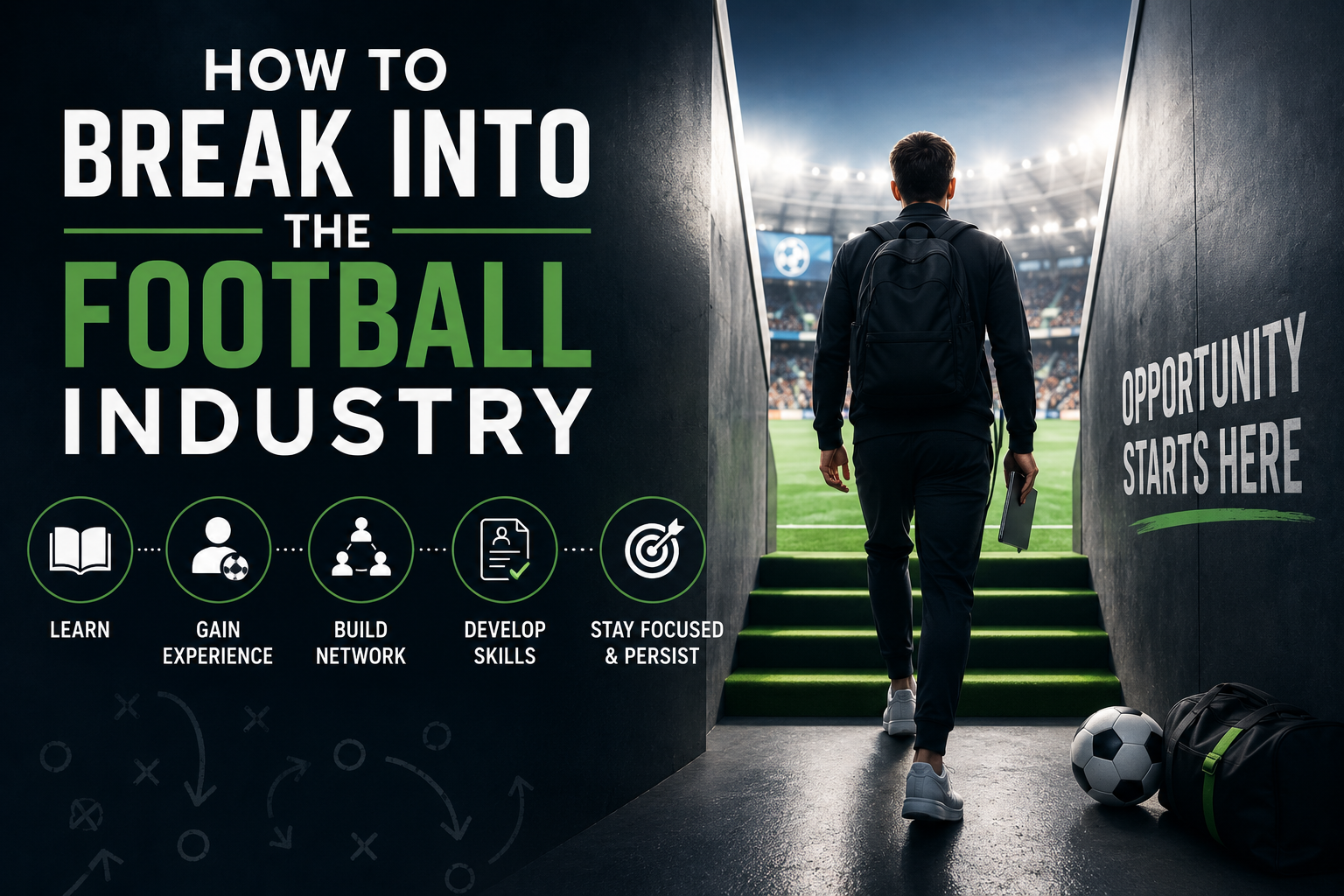
For millions of people, working in football is the dream. Not playing professionally, but being part of the game in another way. Coaching, scouting, performance analysis, player care, sports science, recruitment, operations, media, data, the football industry is vast, and the opportunities are real.
But breaking in isn't straightforward. The pathways aren't always clearly signposted. Competition is fierce. And the industry operates differently from almost any other sector, with its own unwritten rules, its own hiring culture, and its own definition of what makes a credible candidate.
The good news is that people break into football every single week. Not through luck or who their parents know, but through a combination of the right experience, the right network, the right professional presentation, and the right mindset.
This guide gives you a clear, honest, step-by-step roadmap for how to break into the football industry, wherever you're starting from.
One of the most common mistakes aspiring professionals make is treating "the football industry" as a single thing. In reality, it's a collection of very different career paths, each with its own entry requirements, skill sets, and hiring culture.
Before you can break in, you need to be specific about where you want to be. The major career pathways in football include:
Coaching and player development — working directly with players at grassroots, academy, or first-team level. Requires FA coaching licences (starting from the FA Level 1 and progressing to UEFA B, A, and Pro Licence) and significant hands-on experience at the appropriate level.
Performance and sports science — strength and conditioning, sports science, nutrition, and athlete monitoring roles. Typically requires a relevant degree and practical experience in performance environments.
Scouting and recruitment — identifying and analysing talent for clubs at every level. Entry through grassroots scouting, developing a strong analytical eye, and building relationships within the recruitment community.
Performance analysis and data — video analysis, statistical analysis, and increasingly, data science applied to football. A growing area that rewards technical skills alongside football knowledge.
Player care and welfare — supporting player wellbeing, transition, and personal development. Particularly prominent at professional academies and Category 1 and 2 clubs. Increasingly professionalised and regulated.
Football operations and administration — the business side of clubs: finance, HR, marketing, communications, legal, ticketing, commercial partnerships, and more. Often an accessible entry point for those with transferable skills from other industries.
Media, content, and communications — journalism, broadcasting, social media, video production, and club communications roles.
Being specific about which pathway you're targeting shapes every other decision you make — from which qualifications to pursue to who you network with to how you position your CV.
This is the single most important thing you can do, and no amount of qualifications or LinkedIn activity replaces it.
Clubs, at every level, want to know that you can operate in a football environment. That you understand how clubs work. That you can handle the pressures, the personalities, the schedules, and the demands. The only way to demonstrate that is to have actually done it.
Start at grassroots or non-league level. This is where the vast majority of successful football professionals begin, regardless of where they end up. Non-league clubs are generally welcoming to motivated individuals who want to contribute, whether in coaching, analysis, sports science, media, or operations. The environment is less formal, the access is greater, and the learning curve is steep in all the right ways.
Don't dismiss this because it's voluntary or unpaid. The experience is real. The skills are transferable. And the professional relationships you build at this level can open doors further up the pyramid. Treat every voluntary role like it's a professional contract, show up consistently, add value, be reliable, and be professional in everything you do.
Seek out internships and work placements. Many professional academies, clubs, and sporting organisations offer structured placements for students and graduates. These can provide exposure to higher-level environments and give you a direct line to professional contacts. They are competitive, so approach them with a tailored, professional application, not a generic enquiry.
Create your own opportunities. If formal placements aren't available, approach clubs proactively with a specific, low-commitment proposal. Offer to provide match analysis for a local team. Volunteer to coordinate conditioning sessions at a grassroots club. Propose a short-term welfare support project for an academy. Demonstrating initiative by creating your own experience is itself evidence of the kind of drive that clubs want to see.
Qualifications matter, but they matter differently depending on which pathway you're pursuing, and they're rarely sufficient on their own.
For coaching: The FA's coaching pathway is the standard route. Start with the FA Level 1 in Football Coaching if you're new to the game, and progress through Level 2, UEFA B, UEFA A, and ultimately the UEFA Pro Licence. Each level unlocks different opportunities, the UEFA B is broadly the minimum expectation for working in professional academy environments in England.
For performance and sports science: A degree in sport science, strength and conditioning, physiotherapy, or a related field is the standard foundation. Professional accreditation through bodies such as the UKSCA (UK Strength and Conditioning Association) or BASES (British Association of Sport and Exercise Sciences) adds significant credibility.
For analysis: There's no single accreditation pathway here, but a degree in sport science, statistics, or data science, combined with proficiency in analysis tools like Wyscout, Hudl, StatsBomb, or Python, is increasingly expected at professional level. Many analysts build their portfolio through self-directed work before securing their first role.
For player care: The Professional Game Academy Audit Company (PGAAC) framework has driven significant professionalisation in this area. Relevant qualifications span welfare, safeguarding, and personal development, as well as transferable skills from psychology, social work, education, or professional sport backgrounds.
For operations and business roles: Qualifications from your relevant discipline (finance, marketing, law, HR) are your foundation. Football-specific knowledge and networks, built through experience and engagement with the industry, are what differentiate you from a generic candidate.
One important note: pursue qualifications that are genuinely relevant to your pathway and valued by the clubs and organisations you want to work for. Don't collect credentials for their own sake — focus on the ones that open the specific doors you're aiming for.
You can have all the experience and qualifications in the world, and still struggle to break into football if nobody in the industry knows you exist. The football job market is deeply relationship-driven, and building your network is not optional, it's a core part of your career strategy.
LinkedIn is where you start. It's the primary professional platform in the football industry, and it's where connections, conversations, and career opportunities happen. Build a strong, complete profile that clearly communicates who you are, what you offer, and what you're working towards. Engage consistently with content from coaches, club staff, scouts, analysts, and other professionals in your target area. Post about your own work and insights, even short, thoughtful observations can build your visibility over time.
Attend industry events. Coaching conferences, CPD workshops, performance science seminars, scouting conventions, and football business events are all places where relationships begin. Go with a purpose, know who you want to meet and what you want to learn, and follow up meaningfully afterwards.
Build relationships generously and patiently. The biggest mistake people make with networking is treating it transactionally, connecting with people only because they might be able to give you a job. This approach is transparent and rarely works. Instead, be genuinely interested in what others are doing. Share knowledge freely. Celebrate others' achievements. Ask good questions. Be the kind of professional that people enjoy connecting with and opportunities will follow naturally over time.
Ask for informational conversations. Reaching out to an experienced professional to ask if they'd be willing to share their experience, how they got into their role, what a typical week looks like, what advice they'd give to someone coming up, is a perfectly legitimate and often well-received approach. Keep it specific, keep it respectful, and make it easy for them to say yes with a short, focused request.
When an opportunity does arise, your CV and LinkedIn profile need to work hard for you. In a competitive market, a generic, unfocused application will be overlooked.
Your CV should be tailored to every application. The role, the club, the philosophy, the department, all of these should be reflected in how you present your experience. What you lead with, which achievements you highlight, the language you use, all of it should speak directly to what that specific club or organisation is looking for.
Lead with outcomes, not just responsibilities. Don't just describe what you did. Show what you achieved. If you contributed to a player's development, describe the outcome. If you helped a club progress in its audit status, say so. If you implemented a programme that improved a measurable result, state the number. Evidence of impact is what separates compelling CVs from forgettable ones.
Make your professional identity clear. Whoever reads your CV should understand within the first thirty seconds exactly who you are, what you specialise in, and what value you'd bring. Don't make them work to figure that out, communicate it directly and confidently from the top.
Keep it clean, concise, and professionally formatted. Two pages is the standard in football. Use clear headings, consistent formatting, and easy-to-scan structure. Decision-makers in football are busy, your CV needs to be readable in under two minutes.
Jobs4Football Tip: Our Football CV Writing Course takes you through exactly how to build a CV that works in the football industry, with real examples, specialist guidance, and the specific language that gets noticed by clubs and recruiters.
Breaking into the football industry is rarely fast. For most people, it takes months, sometimes years, of consistent effort, gradual progress, and resilience in the face of setbacks. Understanding this going in makes an enormous difference.
Patience is not passive. Being patient doesn't mean waiting around for something to happen. It means continuing to work, learn, connect, and develop during the periods when things feel slow — trusting that consistent effort compounds over time.
Rejection is part of the process, not a verdict. Applications that don't progress, roles that go to internal candidates, conversations that don't lead anywhere, these are part of every football career story, including those of professionals who are now working at the highest levels. How you respond to rejection matters far more than the rejection itself.
Every level of the pyramid teaches you something. Some of the most valuable professional experiences in football happen at grassroots and non-league level, where you have greater responsibility, more direct contact with players, and the freedom to try things and learn from them. Don't be too focused on climbing quickly to notice what you're gaining where you are.
Find your community. The journey is significantly more sustainable when you're sharing it with others who understand it. Connect with people who are on the same path, engage with content and communities built around your chosen area of football, and find mentors who've already walked the road you're on.
At Jobs4Football, we work with serious football professionals at every stage of the journey, from those taking their first steps into the industry to experienced practitioners looking for their next opportunity.
Our platform brings together job listings, career resources, CV guidance, and a community of professionals who understand what it takes to build a career in football. Whether you're a coach, scout, analyst, player care manager, or performance specialist, we can help you get there faster, with less guesswork and more direction.
Explore the Jobs4Football membership platform and start your career in football with a plan.

