The common question we hear everywhere today is, "Can AI replace humans?" And while accountants, lawyers, software developers, and other professions do think about that seriously, football players may relax – no one will ever like seeing AI avatars play instead of live players.
But AI does have the power to reshape football as we see it today in many surprising ways.
In this article, we will discuss the AI innovations that permeate various aspects of the sports game, including season-prediction tips, such as
FIRST's Premier League tips, as well as virtual reality simulations for team training and more.
Let’s get started!
The Use of AI for Training and Rehab
Did you know that AI can calculate each athlete's effectiveness in play by simply checking a photo taken from a mobile phone? In fact, it does.
The technology described is called human pose estimation, which is based on computer vision. This technology enables them to analyze players' pictures and videos, detect the position and angles of their joints during key player poses, and offer tips on how to improve them.
When the player's position during key moves is incorrect, it affects the game's effectiveness. Additionally, players who have learned faulty habits are more prone to injuries.
By analyzing numerous videos and images of successful players, AI algorithms can be trained to establish the so-called golden standard of play, helping to train both professional and amateur football players.
This practice is already being used and may become widespread in the near future.
AI Predictive Analytics
Statistical models have been used in predicting sports game seasons for decades. Yet, AI changes the rules of this game. It provides insight into hidden trends that are not visible to traditional statistical models.
AI can process more data and do so faster. Moreover, modern sensors and innovative equipment are also capable of generating more data than ever before.
For example, bright balls generate data about speed, spin, and rotation, impact point, and trajectory. LIDAR and GPS tracking systems analyze team formations, space utilization, and defensive/offensive transitions, identifying gaps in the opponent's strategy. Wearables allow tracking of distance covered, speed, acceleration, heart rate, body temperature, and fatigue.
All of these data can provide invaluable statistics for match result prediction, player injury prediction and prevention, player performance forecasting, tactical and strategic planning, scouting and recruitment, fan engagement, and fantasy sports.
For example, AI can utilize video analysis, past matches, and player movements to anticipate opponents’ formations, tactics, or substitutions, and generate recommendations on optimal tactics, formations, or pressing strategies.
In another case, AI may be used to predict the outcome of a match by analyzing data on team form, head-to-head results, player injuries, weather, home/away status, expected goals (xG), and other relevant factors. This data can be utilized by bookmakers, fantasy leagues, betting companies, fans, and other interested parties.
Alternatively, a coach can also build an AI app that utilizes GPS tracking, training intensity, fatigue levels, past injury data, and biomechanics to identify players at high risk of injury based on workload and physical metrics. This way, it can reduce player downtime and improve team availability.
Player Training and Simulation
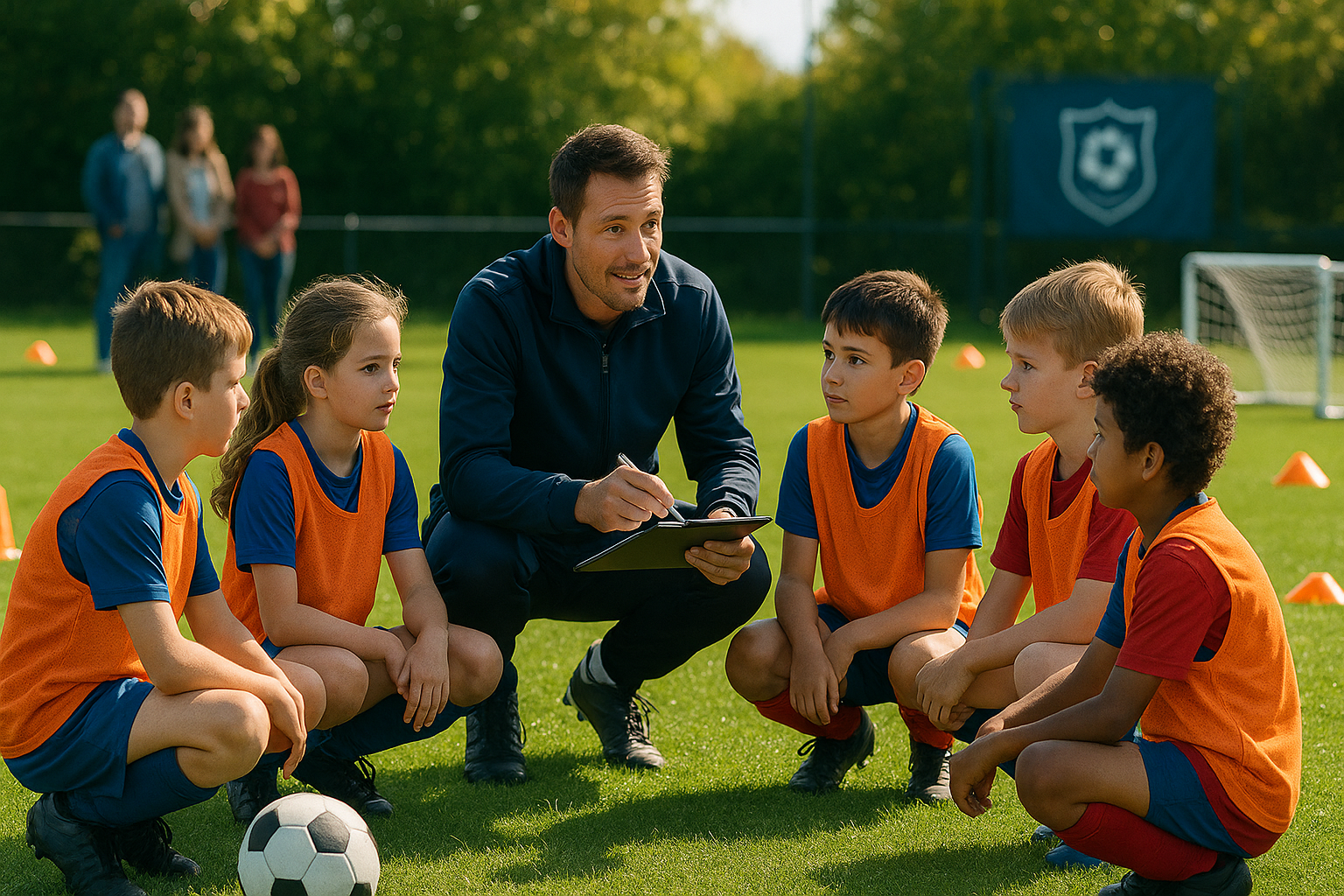
AI can be used to simulate in-game situations and train players how to react to unprecedented situations, including how to press against a high-possession team or respond to a counterattack.
To train AI models of this kind, coaches input data about their opponents. Then, AI creates various tactical scenarios based on that data, and the team is trained to play against the virtual opponent.
In these simulations, teams prepare for specific opponents, which can give them a considerable advantage, especially in tournaments where game preparation time is short.
To immerse players in more realistic game environments, AR/VR technologies are used. Some national teams use VR for training mental sharpness and reaction time; additionally, VR can be used to train players on their opponents' strategies.
It is a great way to develop personalized training programs. For example, AI is used to analyze a player’s strengths, weaknesses, fitness levels, and recovery data. Based on that, the AI-based software can generate personalized training sessions, targeted in one direction, for example, to train in controlling the ball under pressure or how to accelerate properly. Fan Engagement and Broadcasting
The use of AI for personalization is not a novelty; in sports broadcasting, it has numerous applications.
For example, mobile apps based on AI personalization algorithms can send users notifications about their favorite team’s progress, offer personalized discounts for matches, and send reminders before the game starts.
During the game, generative AI can be used to create automated commentary, highlights, or match summaries without the need for commentator teams.
Suppose the watchers require further explanation, historical reference, or additional information. In that case, they may ask AI chatbots or even use them to discuss game outcomes and strategies, just as they would with a professional. It is a great way to learn more about sports, your favorite team, or a particular sportsman.
Refereeing
With the ability to spot many things happening on the field, AI is a valuable aid to referees' decision-making.
For example, by analyzing data from sensors and smart cameras, such as Spidercam, AI algorithms can offer a wider view of what has happened on the field and provide the data to the referee for informed decision-making.
It can offer fast replays of the requested moment from different cameras, making the analysis process faster and more accurate.
Summing Up
AI presents exciting new opportunities for football, ranging from strategy development and opponent game analysis to the creation of personalized training plans tailored to players and teams. In the near future, we can expect even more unexpected applications of AI in football that will transform the way we view this historic sport.