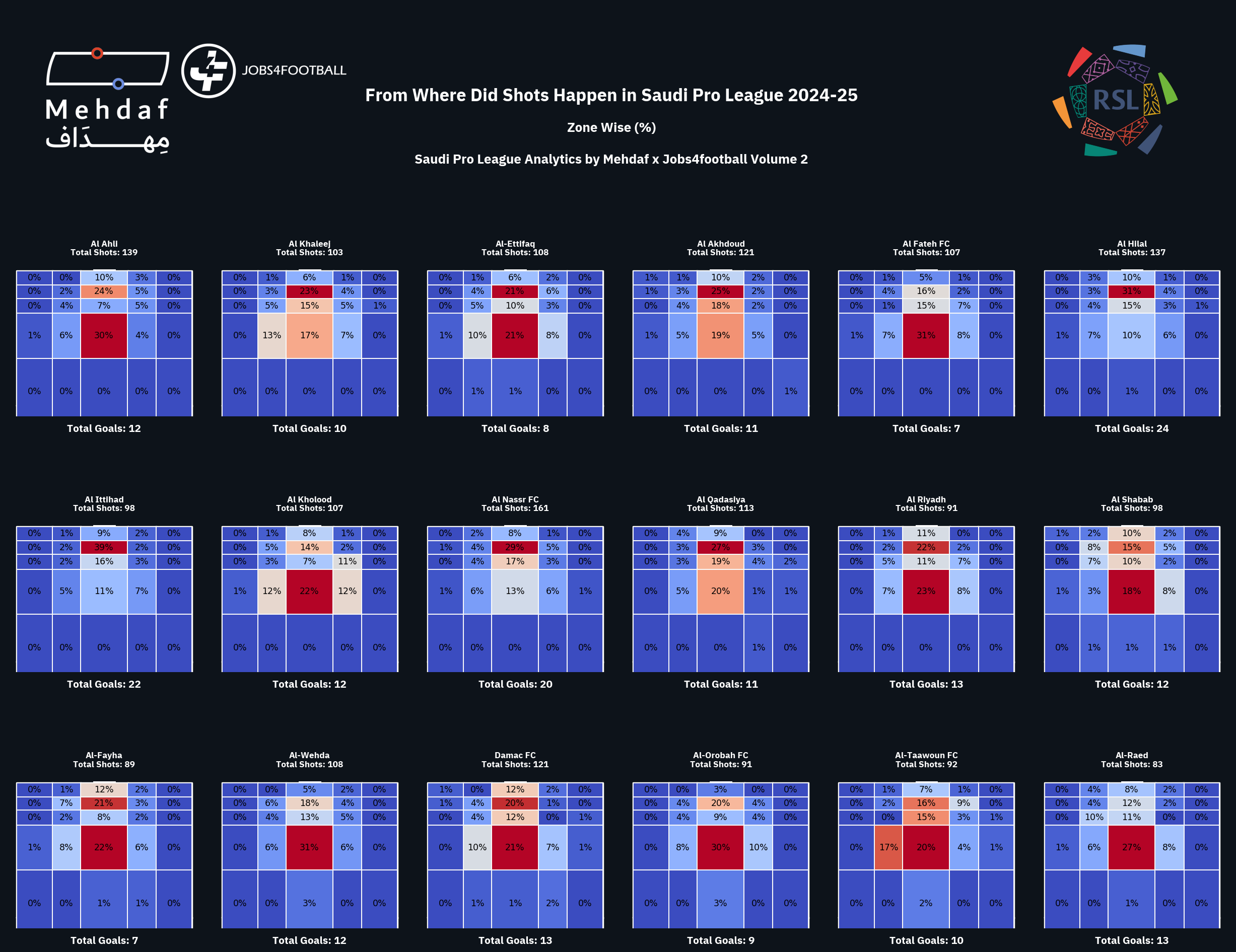
Rising star of Saudi football analytics - Volume Two Saudi Pro League Shot Zones
The Saudi Pro League has been making waves in the global football scene, with its ambitious growth strategy and high-profile signings. As we delve into the second instalment of Saudi born Ahmed Hayyan's innovative data analysis, in collaboration with Jobs4Football, we gain unprecedented insights into the offensive strategies employed by the league's top teams.
Hayyan's work entitled, "Saudi Pro League Shot Zones: Where Teams Are Hitting the Target," showcases his ability to dissect complex offensive patterns and translate them into actionable insights.
Al Hilal, one of the most successful clubs in Saudi Arabia, leads the pack with an impressive 24 goals. Founded in 1957, Al Hilal has a rich history of domestic and international success. The club has won 18 Saudi Professional League titles and is a three-time AFC Champions League winner. Their dominance in the current season is reflected in analysis, which reveals that 31% of their shots come from the 6-yard box, indicating a strong presence in close-range attacking situations. This strategy aligns well with their historical reputation for attractive, attacking football.
Following closely is Al Ittihad with 22 goals. Established in 1927, Al Ittihad is one of the oldest clubs in Saudi Arabia and has a passionate fanbase in Jeddah. The club has clinched 9 Saudi Professional League titles and 2 AFC Champions League trophies. Analysis shows that Al Ittihad heavily favours the 6-yard box, with 39% of their shots coming from this area. This focus on close-range opportunities suggests a tactical approach that prioritizes high-percentage scoring chances, possibly leveraging their strong forward line, which includes international stars like Karim Benzema.
Al Nassr, another powerhouse in Saudi football, ranks third with 20 goals. Founded in 1955, the Riyadh-based club has won 9 Saudi Professional League titles. Hayyan's data reveals that Al Nassr leads the league in shot volume with 161 attempts, showcasing their aggressive offensive strategy. Their shot distribution is more varied, with 29% coming from the 6-yard box and 13% from Zone 14, indicating a more diverse attacking approach. This strategy may be influenced by the presence of global superstar Cristiano Ronaldo, known for his versatility in scoring from various positions.
Interestingly, the analysis also sheds light on teams like Al Raed, Damac, and Al Riyadh, all tied at 13 goals. Al Raed, established in 1954, has been a consistent performer in the Saudi Pro League since their promotion in 2008. Despite having the lowest shot total (83) among the mentioned teams, their effectiveness in Zone 14 suggests a tactical focus on creating opportunities from just outside the penalty area. This approach could be a strategic choice to compensate for potentially fewer chances in more crowded areas closer to the goal.
Damac, a relatively younger club founded in 1972, shows promise with their 5th place ranking in total shots (121). Their success in utilizing Zone 14 indicates a well-structured midfield capable of creating scoring opportunities from distance. This could be a key factor in their competitive performance despite being a less established name in the league.
Al Riyadh, with a rich history dating back to 1953, finds themselves in an interesting position. Despite being tied in goals with Al Raed and Damac, they rank 16th in total shots (91). This efficiency in converting fewer chances into goals suggests a clinical finishing ability or a tactical setup that prioritizes quality over quantity in shot selection.
Hayyan's analysis goes beyond mere statistics, offering valuable insights into the tactical nuances of each team. The prevalence of 6-yard box shots among top teams like Al Hilal and Al Ittihad indicates a league-wide trend towards close-range finishing. This could be a reflection of the tactical setups employed by these teams, possibly emphasizing strong wing play and effective crossing strategies.
The focus on Zone 14 by teams like Al Raed, Damac, and Al Riyadh is particularly intriguing. This area, just outside the penalty box, is often considered a key space for creating scoring opportunities. Success in this zone requires skilled midfielders capable of both accurate long-range shooting and creative playmaking to set up teammates.
As we eagerly anticipate the third installment of this Saudi Pro League data series, it's clear that Ahmed Hayyan's analytical prowess is pushing the boundaries of football data science. His work not only provides valuable insights for coaches and analysts but also offers fans a deeper understanding of the tactical intricacies at play in the Saudi Pro League.
The ongoing collaboration between Hayyan, Mehdaf, and Jobs4Football is a testament to the domestic talent that is the Kingdom . It should also reflect the league's ambition to not only attract top international talent but also to nurture local expertise in all aspects of the sport from operations to analysis.
As the Saudi Pro League continues to evolve and attract global attention, analyses like Hayyan's will play a crucial role in shaping strategies, informing tactical decisions, and enhancing the overall quality of play. This data-driven approach, combined with the influx of world-class players and coaches, positions the Saudi Pro League as an emerging force in global football, both on and off the pitch.